Save the date!
You are invited (and a Plus One) to celebrations on June 30, 2027 when the Dutch Shepherd will become eligible to compete in the Herding Group. This is approved future recognition, not merely a proposal. WoooHooo!
Every good party needs a reason, and this one came from the AKC Board of Directors. In September 2026, the Board approved the Dutch Shepherd breed standard, confirmed the American Dutch Shepherd Association as the breed’s parent club, and set June 30, 2027 as the day the breed would move from the Foundation Stock Service into the AKC Stud Book. That’s full recognition, folks, and for this old Dutch farm dog, it was a long time coming.
How long?
The AKC began recording Dutch Shepherds in 2012 in its Foundation Stock Service, the record-keeping program for breeds working toward recognition. Call it a holding pen, if you will. In 2017 the breed moved up to the Miscellaneous Class, where dogs can be shown but can’t earn championships or compete in a group. Think of that as being let into the party but not onto the dance floor. Beginning June 30, 2027, however, Dutch Shepherds are eligible to compete in regular conformation classes and the Herding Group alongside every other recognized herding breed. Quake in your paws, herding breeds. Dutch Shepherds are ready to roll.
Don’t let the new paperwork fool you. The dog arriving in the showring is far older than its American paperwork, which dates only to 2012. The American Dutch Shepherd Association traces the breed to the farms of the rural Netherlands in the 18th century, more than a hundred years before its first written standard, dated June 12, 1898. The Fédération Cynologique Internationale (FCI), which gave the breed definitive recognition in 1955, describes a job that would wear out most of us. The dog kept sheep out of the crops by patrolling the edges of roads and fields, and it walked the flocks to common meadows, markets and ports. Back on the farm, it kept the hens out of the kitchen garden, gathered the cows for milking, pulled the milk cart and announced any stranger who wandered into the yard. The breed has worn many hats.
By about 1900, most of the Netherlands’ sheep flocks had disappeared, and a lesser dog might have found itself out of work. The Dutch Shepherd simply changed careers, becoming a police dog, a search and tracking dog and a guide dog for the blind. A century later, it had found yet another uniform. By the 2020s, the Dutch Shepherd was one of the breeds the U.S. Department of Defense bought as military working dogs, though Belgian Malinois and German Shepherds far outnumbered it, and in 2019 it was one of four breeds on the U.S. Postal Service’s stamps honoring military working dogs. The American club’s history adds two turning points from the breed’s homeland. In 1914, brindle became the only accepted color, and World War II later pushed the breed to the edge of extinction. Dutch breeders brought it back, and since 2019 the FCI has listed it as a breed subject to a working trial.
In other words, its homeland still expects this dog to earn its keep.
That expectation crossed the Atlantic with the dogs. The American Dutch Shepherd Association was founded in 2010 by seven people who owned FCI-registered Dutch Shepherds imported from Europe. Many of its members also belong to the Nederlandse Herdershonden Club, the breed’s founding club in the Netherlands, and the American club follows that club’s rules wherever they don’t conflict with the AKC’s. Its members breed all three coat varieties. Seven people and sixteen years of patience are how a breed gets its invitation.
Now for the part that will outlast any party. A breed standard isn’t a thumb-through dictionary that works the same way for every breed, and the Dutch Shepherd proves it with a single word. Its standard calls for a head that “is wedge-shaped seen from above and in profile,” with skull and muzzle of equal length. Yet turn to the AKC Labrador Retriever standard and you’ll read that “A wedge-shape head, or a head long and narrow in muzzle and back skull is incorrect.” The same word gets opposite verdicts, and neither standard is wrong. Each describes the dog that breed is meant to be. Carry a term from one breed into another and you can end up faulting exactly the right dog.
In shorthand, you will look foolish and rob the correct dog.
“Middle-weighted,” from the very first sentence of the Dutch Shepherd standard, deserves the same care. Anyone hoping for a number on a scale will be disappointed, because the standard doesn’t give one. It sets heights instead: 22½ to 24½ inches at the withers for males and 21½ to 23½ inches for females. It describes weight as a matter of balance, calling for bone that is “solid and moderate weight in correct proportion to his height,” and “neither too light or too heavy.” The body is slightly longer than tall, at a ratio of 10 to 9, which the FCI standard says is “as suits a trotting dog.” The AKC standard agrees that this is a trotter, one that tends to single-track at speed. It’s a dog built for the long day, not for the scale.
And then there are the coats: short-haired, long-haired and rough-haired. Newbies sometimes assume they’re looking at three breeds. They’re looking at one breed in three outfits, judged under one standard, and every one of them must be brindle on a golden or silver base, with golden ranging from light sand to chestnut red. The rough coat is hand-plucked about twice a year. Its tousled texture can blur the brindle and make the head look squarer in profile, and the FCI standard is refreshingly blunt about that: the squareness “is an illusion.” Under the eyebrows and beard, the wedge is still there.
The standard the Board approved in September 2026 matches, word for word, the one Dutch Shepherds have been judged against in the Miscellaneous Class since 2017. So the breed’s arrival in the Herding Group on June 30, 2027 brings judges no new blueprint, just a familiar dog in a bigger ring.
To the people who brought the breed this far: Well done you! Welcome to the Group. Save us a seat.
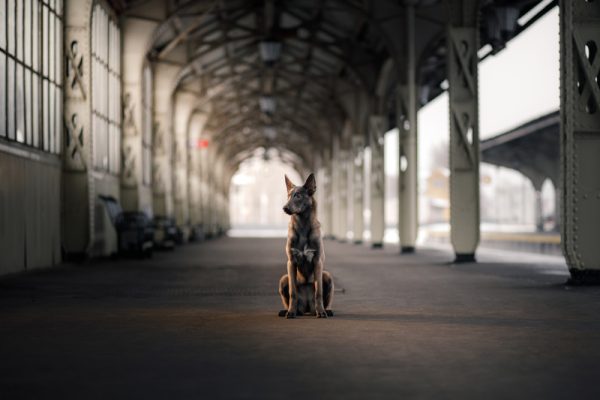
Photo of Dutch shepherd by Annaav | Dreamstime