
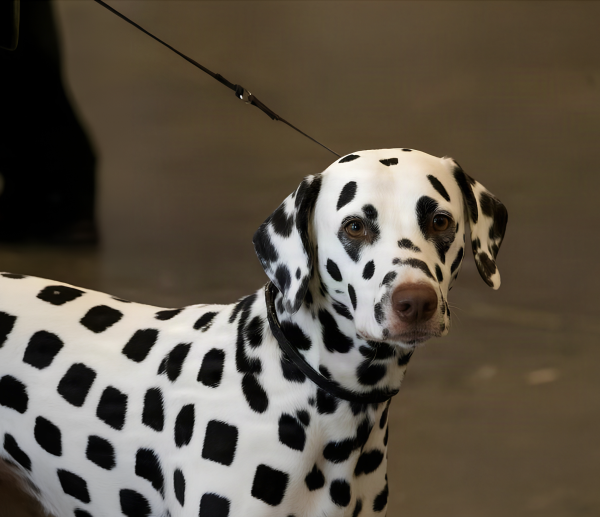
Do you remember being warned as a kid that too much television would give you square eyes?
Nobody ever said what it might do to a Dalmatian. The dog you see here didn’t binge-watch anything; we played with the photo to give it square spots (the original is below). And the reason it looks so wrong is the same reason we think it’s worth asking: why are real Dalmatian spots round, anyway?
Nearly every Dalmatian puppy starts life as a blank canvas. Puppies without patches are born completely white, and the first true spots usually begin to show at about two weeks of age. From there, the pattern keeps developing, sometimes until the dog is more than a year old. Most “dog people” know this.
But here’s a question owners, breeders, and admirers have been asking for generations: what decides how big those spots get, and why are they round?
The honest answer is we don’t know because science hasn’t fully solved it yet. What researchers have found, however, is that the Dalmatian’s coat is built in layers, with several genes each doing a different job. As for the roundness of the spots, even the scientists studying it don’t have the full answer yet. Their best guess is a mix of chance and biology.
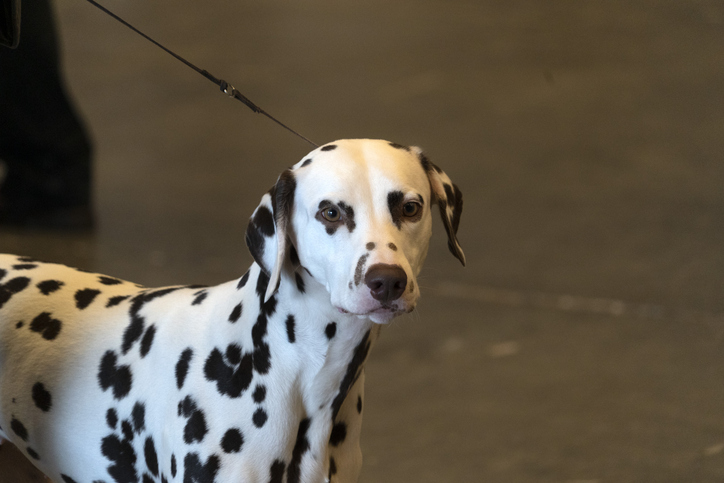
Original Dalmatian Photo by izanbar/istock
The first layer is the white background. MITF is the gene at what’s known as the S, or white spotting, locus, and Dalmatians carry two copies of its most extreme form, called extreme white. That variant removes pigment from nearly the entire coat, giving the spots a clean white field, so to speak, to sit on.
The second layer is what brings color back into that white. For decades, the spots were explained as a form of ticking, the small flecks of color seen in white areas on many sporting breeds. That idea traces back to breeding experiments by geneticist C.C. Little. In 2021, however, two research teams changed the picture. Kawakami and colleagues tested 262 purebred Dalmatians and found that every one of them carried the same duplication in the USH2A gene that is strongly associated with roaning in breeds such as the Australian Cattle Dog. Brancalion and colleagues, working separately, reported that the Dalmatian version of this gene region more closely resembles roan than ticking. Dalmatian spots also share two traits with roan: color appears in white areas in the first weeks after birth, and it spreads evenly across the body. Even so, the researchers didn’t conclude the case was closed. Kawakami’s team proposed that the spots arise from an interaction between the roaning gene and a second, still uncharacterized gene.
That proposed second gene is the third layer, and it appears to be important for spot size and crispness. A roaning or ticking gene by itself would produce small flecks or a mottled coat. What appears to turn those flecks into large, solid, well-defined spots is a modifier usually called flecking, or the F locus. Even its exact role is debated: researchers aren’t certain whether it enlarges the spots, keeps white hairs out of the black spots, or both. Breeding studies of Dalmatian and English Pointer crosses suggest it works recessively: dogs that inherit two copies of the recessive form have spots free of scattered white hairs. Without that modifier, the markings look muddled and roan-like, more like what you’d see on a ticked or roan dog than on a Dalmatian.
Researchers have narrowed down where this modifier lives, but they haven’t found it. Breeding studies by geneticist Robert Schaible in the 1970s found that this spot modifier tends to be inherited together with the breed’s high uric acid levels. In 2008, Bannasch and colleagues traced the uric acid trait to the SLC2A9 gene on chromosome 3, which places the modifier in that same neighborhood. Kawakami’s team later found a promising variant in a nearby gene, RHOH. Ninety-eight percent of the Dalmatians they tested carried two copies, but some dogs without Dalmatian-like spots carried it too, so it can’t be the whole explanation.
Spot color is a whole separate matter altogether.
A 2005 study by Cargill and colleagues found linkage evidence tying black versus liver spots to the TYRP1, or Brown, gene. Under that model, dogs with at least one dominant copy have black spots, and dogs with two recessive copies have liver spots, though the exact variant involved still hasn’t been pinned down. A Dalmatian’s spots are either black or liver, never both on the same dog.
Even with the genetics sorted into layers, no one has a map that tells each spot where to go. Darn. That said, it’s the focus of a research project led by Dr. Richard Mort at Lancaster University, working with the University of Bath, which notes that spot formation may involve both chance and biological rules. The team is studying how pigment cells behave in the skin and hair as an animal grows.
Location on the dog’s body plays a role, too. The Dalmatian Club of America standard notes that spots are usually smaller on the head, legs, and tail than on the body, and the club’s Illustrated Standard adds that it’s common to see more intermingling on the ears and underside.
The standard itself describes the ideal: spots that are round and well defined, the more distinct the better, ranging from the size of a dime to a half-dollar, and pleasingly and evenly distributed. The Illustrated Standard reminds judges that ticking is not spotting and that excessive ticking detracts from breed type. It adds, separately, that spots larger than a half-dollar also detract from breed type. It’s also worth knowing that a patch isn’t simply an oversized spot. A patch is a solid mass of black or liver hair that’s present at birth, and the standard doesn’t allow it. Spots develop afterward. Areas where spots have run together aren’t patches either; they usually have uneven edges and may contain scattered white hairs.
In other words, the genes make the spots solid, chance helps decide where they fall, and generations of breeders working toward the standard have kept them round.
So the next time you admire a well-marked Dalmatian, you’re looking at extreme white, a roaning gene, a still-unidentified modifier, and a bit of developmental chance, all refined by generations of breeders who knew exactly what a proper spot should look like. And if you ever do see a Dalmatian with square spots, holler at us. We might know some TV and movie agents who’d be interested.