The modern registered and show Bearded Collie was revived in the 1940s by Mrs. G. Olive Willison of Bothkennar. In January 1944, Willison had arranged to acquire a working Shetland Sheepdog from Scotland, but oops! The puppy sent to her was instead a Bearded Collie—the brown bitch later known as Jeannie of Bothkennar. Enchanted by Jeannie’s temperament, intelligence, and working instinct, Willison looked for a suitable “husband,” establishing the Bothkennar line that became the foundation of the modern show breed.
But what came before? Our honest answer is that as far as we can tell, the Bearded Collie’s remote origins can’t be proved. Scotland had long produced shaggy, hairy-faced working dogs valued for their ability to handle sheep and cattle in difficult weather and rough country. These dogs were known by a variety of regional names, including Scotch Sheepdog, Mountain Collie, Highland Collie, and Hairy Mou’ed Collie. Their exact relationship to the modern, standardized Bearded Collie is obscured by the fact that shepherds and drovers bred primarily for working ability, not for written pedigrees or uniform type.
Several theories have been repeated over the years. One links the breed to Polish sheepdogs said to have reached Scotland in the sixteenth century; another proposes Central European, including Komondor, influence. Still another imagines an unbroken native lineage of shaggy Scottish “hill dogs,” sometimes pushed back as far as the Roman occupation. These stories are intriguing, but they remain conjectural: there is no contemporary evidence sufficient to establish any one of them as the breed’s definitive origin. What can be said with confidence is that long-coated, bearded working collies existed in Scotland for ages, if not centuries, and were shaped by the real demands of hill and farm work.
Late-eighteenth-century paintings are often cited as early visual evidence of Beardie-type dogs. A Gainsborough portrait of the Duke of Buccleuch, traditionally dated 1771, and a Reynolds portrait of the Duchess and her daughter with two dogs are regularly identified in breed histories as early depictions. A more recognizable “Sheepdog” appeared in Reinagle’s Sportsman’s Cabinet in 1803, and an 1818 Live Stock Journal description is frequently cited as further evidence that the type was established by the early nineteenth century.
By the late Victorian period, Beardies were being exhibited in Scotland. The 1897 Edinburgh Show of the Scottish Kennel Club is generally considered the first show at which the breed was classified, with a separate working-dog class restricted to shepherds and drovers. Yet the breed’s exhibition fortunes remained precarious, and the disruption of two world wars nearly ended its presence in the registered show world. In 1959, The Kennel Club made Bearded Collies eligible for Challenge Certificates and championships. That year, Willison’s Ch. Beauty Queen of Bothkennar won the first three CCs offered to the breed and became its first British champion
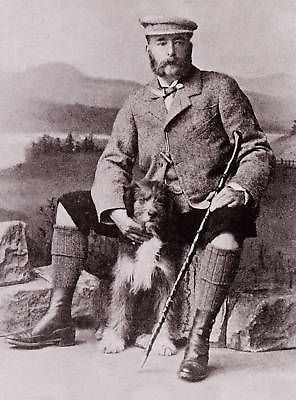
Image of the President of the Scottish Kennel Club in or around 1900, Panmure Gordon, with a Bearded Collie; Photograph by James Ewing, Aberdeen. From Charles H. Lane, Dog Shows and Doggy People (London: Hutchinson & Co., 1902). Public domain.