‘Ever hear the expression, “Everything old is new again?” Do we have a breed for you!
The Podenco Orito is described by some as a “new” Spanish breed, but there is nothing new about it. Oritos have always been around in Malaga, Spain, but there were so few of them, and only in specific areas, that the breed nearly vanished. It didn’t help when Oritos were bred with other podencos, and worse, with breeds not even remotely close to being podencos.
We came across one more reason that the Orita fell into trouble, and sadly, it had to do with color. In rural areas, “orito” was any animal (including dogs) that had black or brown hair with chocolate colored reflections of gold, or “oro.”When the Podenco Andaluz standard was written, however, chocolate brown or black with reddish brown markings were excluded from the section on color, and that lead to some people to ignore pondecos of those colors.
Orito enthusiasts – mostly rabbit hunters – remembered the Orito as a breed that had always been present on the banks of the Genil and the Guadalhorce, Malaga, because they were the best to hunt the rabbits in extreme conditions of weeds and moisture. Some were convinced, in fact, that the Orito was the ancestor of all existing Podenco breeds on the Iberian Peninsula. They pointed out that the Orito could adapt to any surface, wet, hard, soft or dry, and in all conditions. One Gaspar Jiminez said, “What other dogs cannot reach, the Orito always will.”
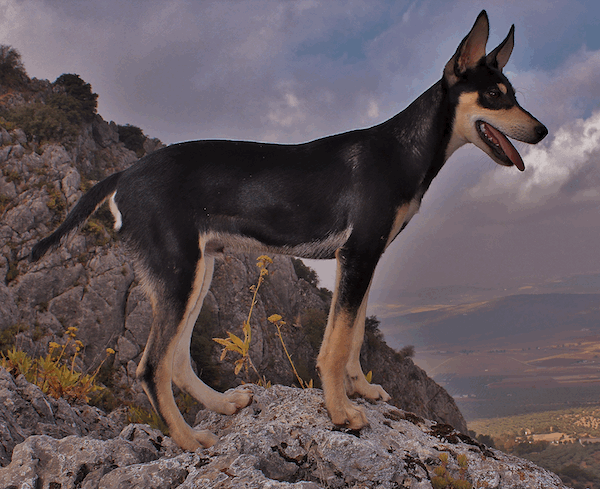
If you have been following NPDD posts of late, then you know that the Orito is the latest installment in our series on podenco breeds. Until now, phenotypical traits of podencos have been similar across the board. The Orito, however, is different, and you can see it in the image above. The Orito’s coat is different. His skin is “harder,” and he has a protective undercoat more profuse than in other podencos. His features, too, are different. A couple sources even point to “flexible toes” as a reason these dogs are to negotiate difficult terrain.
The good news is that the Podenco Orito is said to be increasing in numbers, and the first meeting of the Asociación Nacional del Podenco Orito Español held in 2009 was the first step at getting the breed recognized by the Sociedad Canina Española. The breed is well worth saving! Noble and intelligent, these dogs are affectionate and easy to train for pondenco. They share the great sense of smell, sight and sounds that other podencos have, but this one adapts very well to almost any climate.
Image of a Podenco Orito found on Pinterest and happily credited upon receipt of information
Hello. I adopted a dog from Spain (sold as Pinscher Mix) that appeared to be an Orito, referring to the images I‘ve seen in the INet. I would like to be sure about this dog also because of caring about the race of Oritos. Would a Gene Analysis be more precise?
Please provide a contact to any kind of Organisation, involved in this topic.
Thank you so much for giving this dog a home and for caring enough to look into the Orito type. The Podenco Orito is quite a rare, regional Spanish hunting dog, and many general dog DNA tests do not yet list it as a separate breed in their databases.
A good-quality DNA test can still be useful, but it is more likely to identify broader Podenco/mediterranean hound ancestry or related breeds and types, rather than specifically confirming “Podenco Orito” by name. The results are therefore best used as one more piece of information alongside photos, structure, and behavior, not as an absolute answer.
For organizations, you might try contacting Podenco rescue and education groups, as they often have experience with Orito-type dogs and knowledgeable breeders or historians they can refer you to (for example, Podenco-focused rescues and educational pages, as well as Spanish Podenco enthusiast communities). You can also look for online groups or pages that specifically mention “Podenco Orito” or “Orito Español,” where people working to preserve or document this type tend to gather and share information