An earlier post about the Braque du Bourbonnais noted the breed’s official inclusion in the Imported Breed Register of the Royal Kennel Club. And you wouldn’t know it to look at that sentence, but it led to some confusion around these parts.
And it wasn’t about the breed.
It was about that name: “the Royal Kennel Club.”
Was this a new entity? Had we missed a merger, a coup, a very dignified hostile takeover? We had questions.
And the obvious question was this: Are the Royal Kennel Club and the Kennel Club two different organizations? We learned that they are not, they’re the same organization, and it is a “royal” rebrand.
We go back to the beginning on April 4, 1873 when Sewallis Evelyn Shirley, a Member of Parliament, and twelve other gentlemen—including the Reverend John “Jack” Russell of terrier fame—met to bring some order to the rapidly expanding worlds of dog shows and field trials. Their goal was to establish consistent rules so that these events would be conducted fairly, honestly and with some consideration for the dogs’ welfare. It became the world’s first national kennel club then called “the Kennel Club.” As an aside, today it is Britain’s principal canine registry and the organization that governs events held under its rules. Its authority comes from the registrations, clubs, societies, exhibitors and competitors that voluntarily agree to operate under its rules.
As for the new name, it was on the occasion of the club’s exact date of its 150th anniversary that King Charles III granted it the right to use the Royal prefix. The honor acknowledged a royal association that had existed from the beginning. The Prince of Wales, later King Edward VII, became the club’s first Royal Patron in 1873, and successive monarchs continued the relationship.
The corporate name was formally changed at Companies House from The Kennel Club Limited to The Royal Kennel Club Limited on August 29, 2024. The company is recorded as a private company limited by guarantee without share capital—not a government department and not a commercial company owned by shareholders. The organization didn’t publicly unveil its new identity, branding and initials, however, until November 25, 2025. From that date, it began presenting itself consistently as The Royal Kennel Club, or RKC, rather than simply The Kennel Club, or KC, which explains why we were behind the eight ball, so to speak, in being aware of the change. Much of the material we looked into in research predates the name change, but it’s the same club founded in 1873, now wearing a crown in its name. The new Royal designation does not give the club new powers; it is an honorific—and a rather significant one—but not a transfer of authority from Parliament or the Crown.
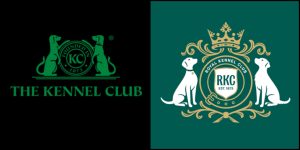
The image at the left is the Kennel Club’s old logo, the one at the right is the new one.
For those new to the dog fancy, we have two things to mention. The first is the term, “dog fancy.” It sounds archaic today, but fancy once meant both a specialized enthusiasm and the community devoted to it. Derived from fantasy, the word evolved from describing a personal liking—someone “taking a fancy” to something—to identifying organized groups of enthusiasts known as fanciers. Britain’s dog fancy grew largely from the older pigeon and poultry fancies and from the breeding and exhibition of prize livestock, all of which emphasized pedigrees, selective breeding and competition. As modern dog shows emerged in Britain beginning in 1859, followed by the founding of the Kennel Club in 1873, “the dog fancy” became the customary name for the interconnected world of breeders, exhibitors, judges and breed authorities. The term crossed the Atlantic during the latter half of the nineteenth century with British dogs, dog-show customs and kennel literature, becoming established in the United States as organized shows and kennel clubs developed during the 1870s and 1880s. Although now decidedly old-fashioned, it remains in use within purebred-dog circles to describe the organized sport and its participants, not simply everyone who happens to like dogs.
The other thing we want to explain to “newbies” is that “Royal Kennel Club recognized” and “FCI recognized” are not interchangeable. The UK’s Royal Kennel Club isn’t a member of the Fédération Cynologique Internationale, or FCI. It maintains its own breed-recognition system, breed standards, titles and regulations. It does, however, accept certain registrations and documentation from FCI member countries and from kennel clubs with which it has reciprocal arrangements. A breed may therefore be recognized by the FCI but remain on the British Imported Breed Register—or not be recognized by the Royal Kennel Club at all.
We circle back to where we started, the name change. The mystery is resolved: no intrigue, not a competing registry, just a 150-year-old institution granted the crown it was quietly entitled to all along. It’s business as usual, conducted exactly as Shirley, Russell, and their eleven fellow gentlemen envisioned over what one imagines was a very serious cup of tea in 1873 — or, more likely, something considerably stronger.
Original photo of Bulldog by Curated Lifestyle from Unsplash. Amended photo to include crown by NPDD