When a Karelian Bear Dog barks at a black bear in, say, a Lake Tahoe neighborhood, it is drawing on centuries of Finnish and western Russian breeding for work on large game, including brown bear. The bark that once served the hunter now serves the bear. In Nevada, the goal is to send that bear back to the woods a little wiser, a lot more wary of people — but alive
Wildlife managers have two words for this kind of work, and although the public, the press and even some agencies use them interchangeably, they mean different things. Hazing is the immediate use of human activity or deterrents to change an animal’s behavior right now: noise, shouting, a barking, charging dog, a rubber projectile. A bear is in the campground; the bear needs to leave the campground NOW. Parks Canada calls hazing “a one-time action.”
Aversive conditioning asks for something harder. John B. Hopkins, the lead author of a 2010 paper that set out the standard definitions bear managers now use for hazing and aversive conditioning, defined it as “a learning process in which deterrents are continually and consistently administered to a bear to reduce the frequency of an undesirable behavior.“
Hazing targets a moment; conditioning targets a habit.
A bear that has learned that garbage cans and bird feeders mean dinner has to learn, through repetition, that people and their property mean more trouble than it’s worth.
The confusion is common enough that ten bear specialists, among them the Nevada Department of Wildlife’s longtime, now-retired bear biologist Carl Lackey, published a 2025 paper in the journal Ursus calling for standardized terms. “Often and incorrectly,” they wrote, “hazing is referred to as ‘aversive conditioning,'” adding that “hazing is different in that it is neither continual nor consistent.”
So which tool gets used, and when?
Hazing is the everyday response to an immediate conflict: the bear on the porch, the coyote trailing a dog walker, the elk in the schoolyard.
Aversive conditioning requires consistent follow-up directed at the particular behavior managers want to change, and that takes time, trained staff, trained dogs, and repeated contact that many agencies cannot spare. The familiar “hard release,” in which a captured bear is set free with a deliberately unpleasant send-off of noise, rubber projectiles or dogs, is defined by the Association of Fish and Wildlife Agencies (AFWA) as a hazing method. It becomes part of a conditioning program only when it is repeated consistently as part of a larger plan. Neither approach lasts if the reward remains. A bear with continued access to trash has little reason to change its mind.
Species matter, too. Hazing is a common tool for discouraging urban coyotes from approaching people. State wildlife agencies coach residents to wave their arms, shout and keep at it until the animal leaves. Canada geese are hazed as well, and they usually return quickly to preferred sites once the pressure stops. Hoofed animals respond strongly to anything that looks like a predator, which makes them good candidates for both approaches. Bears whose problem is a learned habit are the classic subject for aversive conditioning, although AFWA’s review notes that deeply food-conditioned bears are among the hardest to turn around.
That is where the dogs come in. Nevada’s program uses Karelian Bear Dogs alongside trained biologists to pressure bears out of neighborhoods and campgrounds and back toward suitable habitat, and the department states plainly that the dogs are not used to harm bears. The dogs also flush bears from urban dens, locate injured bears and work releases, the Tahoe Daily Tribune reports. Washington’s Department of Fish and Wildlife uses the breed for capture, tracking and hazing. Much of this work traces to bear biologist Carrie Hunt, who founded the Wind River Bear Institute in 1996.
Even the handlers are careful not to oversell their canine partners. “The dogs are amazing tools to haze the bears,” NDOW biologist Becca Carniello told the Tahoe Daily Tribune, “but they aren’t going to make a permanent behavior change. The only permanent long-term solution comes from people securing their attractants.”
The Karelian Bear Dog may be the best known of these working dogs, but it hardly works alone. In a New Jersey aversive conditioning study, two Black Mouth Yellow Curs chased black bears during hard releases that also used rubber buckshot and pyrotechnics. In a Louisiana study using black-mouthed curs, 10 of 11 treated bears returned to nuisance behavior within five months. Montana Fish, Wildlife and Parks used two Airedale Terriers to haze grizzlies on the state’s northern prairie: the dogs moved bears at least 200 meters 57 percent of the time, while drones succeeded 91 percent of the time. That same study cites Laikas used in Russian bear management, and Inuit in Arctic Canada have used the Canadian Eskimo Dog for centuries to attack and hold polar bears at bay.
Hoofed animals have their own canine specialists. In Banff National Park, researchers used Border Collies with a professional handler to chase habituated elk in predator-like pursuits, and both the dog and human treatments made the elk significantly more wary, at least temporarily. At Glacier National Park, a Border Collie named Gracie, trained at the Wind River Bear Institute, moves bighorn sheep and mountain goats away from the Logan Pass parking lot. She works only with hoofed animals, never bears or other predators. Animals she moved stayed away for 15 minutes to nine hours, compared with 10 to 15 minutes after conventional hazing. Border Collies are also a common choice for clearing Canada geese from golf courses, airports and natural areas.
Then there are the dogs that guard rather than chase. The Great Pyrenees, the Akbash and the Komondor, all livestock guardian breeds, have been used to reduce bear damage to livestock and beehives. Their work is better described as deterrence than hazing. They stay with the flock or the hives and repel bears through vigilance, barking and defensive behavior when one comes too close.
A bear that keeps its distance from people is far more likely to keep its life, and these dogs, bred for other work entirely, are helping it learn that.
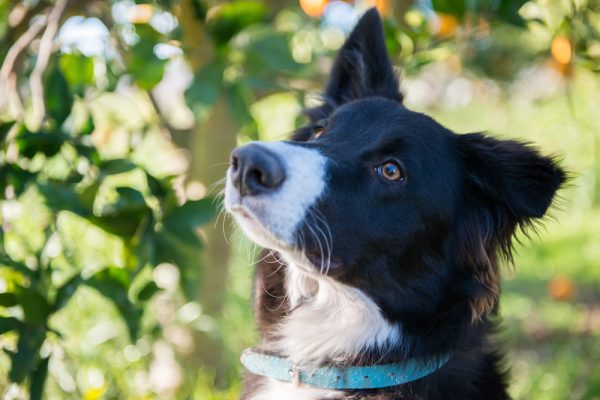
Photo of Karelian Bear Dog by Wirestock/Depositphotos