
The Norwegian Elkhound’s AKC and UKC breed standards specify that any overall color other than gray is a disqualification, including solid black, red, brown, white, or other solid colors. This does not mean that no Elkhounds exist in other colors; it means that, within those standards, gray is the only accepted overall color for the show‑ring Norwegian Elkhound.
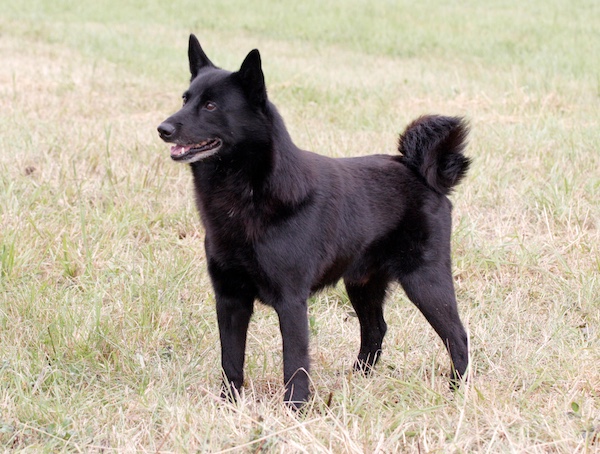
Opinions vary about the Black Norwegian Elkhound. Some authors describe it as one of the most ancient Scandinavian hunting spitzes, asserting that dogs of this general type have existed since the Stone Age and citing very old Scandinavian hunting dogs as precursors. Other expert sources treat it as a younger, distinct but closely related breed that was developed in the nineteenth century as a somewhat smaller, solid‑black hunting Elkhound in Norway and along the Norwegian–Swedish border, and now considered by many cynological authorities to be a closely related, separately recognized Elkhound breed, rather than a simple color variety of the AKC Norwegian Elkhound.
We can’t categorically say.
Much of the Black Norwegian Elkhound’s working history is shared with the gray Norwegian Elkhound: both were used in Scandinavia for hunting large game such as elk (moose) and bear, and both belong to the traditional “elghund” (elk‑dog) type. In the late 1800s, however, Scandinavian breeders developed a solid‑black strain that was especially associated with the inland valleys of eastern Norway and the Norwegian–Swedish border regions, and these dogs were later formally recognized in Norway as a separate breed. Whether those breeders were consciously trying to legitimize what had become a disqualifying color in the gray Norwegian Elkhound, or whether long‑term selection for gray show dogs had reduced the visible black gene pool in the main Norwegian Elkhound population while hunters in certain regions retained black dogs, is not clearly documented in the available historical sources.
While contemporary kennel organizations in Scandinavia register the Black Norwegian Elkhound separately and describe it as a distinct breed, its practical reality is more nuanced. In type, function, and shared history it remains very close to the gray Norwegian Elkhound, and some fanciers still regard it as a regional or historical color‑based offshoot rather than a wholly independent breed. Given the overlapping roots and similar work they perform, it may be most accurate to think of the Black Norwegian Elkhound as a closely related Scandinavian Elkhound population that modern registries have chosen to recognize separately, rather than to take an absolute position on whether it is—or is not—a “bona fide” separate breed.
Photo of a dog identified as a Black Norwegian Elkhound by Roger Tillberg/Alamy