Most gardeners quickly learn the challenges of sandy soil and clay. Sand drains fast after rain and dries out quickly. Clay drains slowly, holds a lot of water and bakes hard in summer. Anyone who has watered a sandy bed in the morning and found it dry by supper knows the difference.
So what does this have to do with a dog?
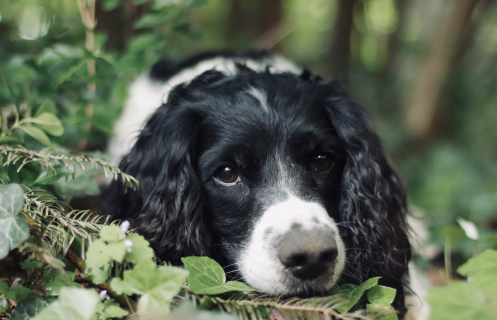
Meet Freya, an English Springer Spaniel whose job in England is finding great crested newts. Born in 2015, Freya was trained with positive reinforcement and put to the test by her owner and handler, ecologist Nikki Glover. In a study published in PLOS ONE on June 7, 2023, we read that when Freya finds a newt, she tells Nikki by lying or sitting down.

Freya first found newt scent through pipes up to 2 metres long. Then she searched for newts buried under about eight inches of sand or clay. Some had a vent: a narrow mesh tube running to the surface, standing in for the mammal burrows newts often use. Over 128 searches, including plots with no newt, she was right 88 percent of the time.
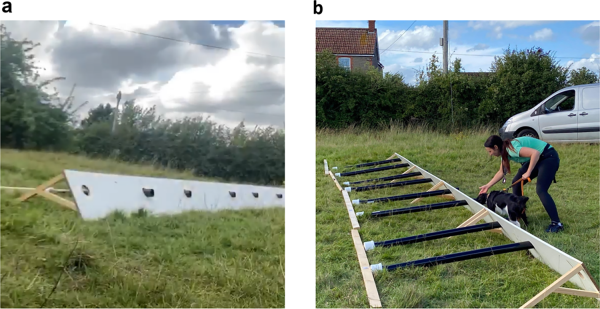
Photo: Glover et al. (2023), PLOS ONE, Figure 3. CC BY 4.0. Source.
Here’s where gardeners knowingly nod. Freya found newts faster when a vent was there, and she was slowest through sand with no vent. Some of her finds there took the full three minutes she was allowed, while her finds through unvented clay took 50 seconds or less. The sand in the trials was dry and the clay was wet. The authors suggest moisture in clay may carry newt scent upward, or dry sand may absorb scent compounds. But moisture wasn’t tested on its own, so whether soil type, wetness or both slowed Freya remains unknown.
Why go to such trouble over a newt?
Great crested newts have declined sharply across Britain and Europe. The main cause is lost ponds, made worse by pollution, fish that eat newt larvae and building that cuts ponds off from the land around them. British law now protects the newts and their breeding and resting places, so they have to be found before construction near a pond can begin. That’s where Freya earns her keep.
And they are worth saving, for practical reasons as well as sentimental ones. Amphibians are the most threatened group of animals with backbones on earth, with about 41 percent of assessed species threatened with extinction. They eat huge numbers of insects, including crop pests and mosquitoes. When a fungal disease wiped out frogs and salamanders in Costa Rica and Panama, malaria cases in those areas rose for years afterward. Researchers linked the two, though they couldn’t confirm that more mosquitoes were the reason. Amphibian skin also produces compounds being studied for new medicines. And because that thin skin absorbs whatever is in the water, amphibians are early warning signs of pollution that may also affect wildlife and people.
Which brings us back to the garden. Gardeners meet newts more often than they might think. Newts shelter in log piles, hedge bottoms and compost heaps, and under stones and paving slabs. Anyone digging into a compost heap in spring is advised to watch for them. Newts are allies, too: along with frogs and toads, they eat slugs, and they’ve even been seen climbing plants to hunt them. A fish-free pond with one sloping side, long grass at its edge and a log pile nearby gives newts what they need.
In Britain, a pond with great crested newts comes with responsibilities. Pond clearing belongs between early November and late January, when the newts are least likely to be in the water. Anyone who finds great crested newts during the work should stop. Right now, in mid-November, newts are settling into their winter hiding places, so the woodpile and compost heap deserve a gentle touch.
So why should a newt in an English field matter to people who love purebred dogs?
Because Freya is doing a modern version of the work her breed was made for. Springers take their name from their original job: springing, or flushing, birds and small game from cover so the hunter could take them. Even today, a Springer in the field is expected to find birds in high grass or bramble. A dog bred for centuries to hunt by nose through thick cover is a natural fit for searching log piles and burrows. Glover herself said it was clear from Freya’s first training sessions that she “was born to do the job.”
The study also shows something purebred-dog fanciers understand well: a breed’s gifts are worth testing, not just praising. Freya’s success took years of training and a careful handler. She is one dog with one handler, and whether other Springers could do the same hasn’t been tested. Still, the traits breeders have protected for generations, the nose, the drive and the willingness to work with a person, are now helping protect a rare amphibian. And many dog lovers are gardeners, too. The next time a Springer, or any dog, stops to sniff hard at the compost heap, there may be more under there than they realize.
Top photo by Rafaëlla Waasdorp/Unsplash