A breed standard doesn’t merely describe an attractive and sound dog; its precise wording establishes the boundaries by which the breed is evaluated and breeders create the next generation of dogs. Which is why adding one small word can deserve considerably more attention than its size suggests.
In the Miniature Bull Terrier’s former AKC standard, the instruction for colored dogs was brief: “any color” should predominate.
The 2026 revision changed that to “any allowed color”—and then supplied a list and a disqualification. Suddenly, “any” had boundaries spelled out in black and white.
AKC approved the revisions at its January 12–13, 2026 Board meeting, with an effective date of April 1, 2026. According to the Board record, this was the first revision since the breed’s AKC recognition in 1991, and color was the principal change.
So, what colors are allowed now?
White remains, under the same basic wording as before: a pure white coat, with head markings and skin pigmentation not penalized. For colored dogs, the standard now specifically names:
-
Brindle
-
Black brindle
-
Black and tan
-
Red
-
Fawn
Those colored coats may occur “with or without white and/or smut markings,” and an allowed color must predominate. Then comes the sentence that gives the list its teeth: “Any other color is a disqualification.” Blue eyes are also now explicitly disqualifying.
There is an important distinction here. These five named colors were added to the standard’s wording; that doesn’t mean five previously forbidden colors have suddenly been admitted to the breed. What disappeared was the open-ended phrase “any color.” What arrived was an express list backed by a disqualification.
Nor has tricolor quietly vanished. The revised wording permits black and tan with white. The British Miniature Bull Terrier Club’s color guidance helps connect the terminology: it lists “Tricolour – Solid Tri (black & tan).” Readers shouldn’t mistake the absence of the word “tricolor” from the AKC list for the elimination of the familiar black, tan and white dog.
What about blue, liver, chocolate, lilac or merle? None is named as an allowed color or pattern in the revised AKC wording. The published revision does not identify these colors individually as previously accepted colors being removed; it replaces broad wording with an explicit permitted list. An article about precise wording ought to be precise itself, right?
The natural next question—and our favorite—is why. AKC identifies color as the primary change, but its published approval does not explain the parent club’s specific reasoning. It doesn’t identify a particular dog, breeder, disputed judging decision or emerging color as the trigger.
There is, however, relevant breed-club context. Britain’s Miniature Bull Terrier Club has published an explicit warning about puppies marketed in “exotic” or “rare” colors. It names merle, lilac and chocolate, states that these colors do not occur naturally in the breed, and attributes their introduction to crossing with other breeds. That is the British club’s published position—not an explanation of what prompted the American ballot.
Did the FCI, or the United Kennel Club here in America, follow AKC’s lead? Their currently published Miniature Bull Terrier standards do not show a matching adoption of the 2026 AKC language. Both already addressed colors that the old AKC wording left unnamed.
The FCI standard allows white and says that color should predominate in colored dogs. It gives brindle preference when other things are equal and specifically accepts black brindle, red, fawn and tricolor. Blue and liver are “highly undesirable,” while tick markings in a white coat and blue or partly blue eyes are described as undesirable. These are not listed as specific disqualifying faults in that standard.
UKC likewise recognizes white and colored dogs. Its colored section begins “Any color other than white,” identifies brindle as preferred, and also names red, fawn and tricolor. White markings are allowed, provided color predominates. Blue or liver coats, ticking in a white coat, and blue or partially blue eyes are faults—not the specific color and eye disqualifications now found in the AKC standard.
That difference matters. A fault is a departure from the ideal to be weighed under the standard’s instructions. A disqualification is not simply a stronger preference: UKC’s own explanation says that a dog with a disqualification must not be considered for placement. “Undesirable,” “fault” and “disqualification” are not interchangeable labels.
AKC, meanwhile, names brindle without giving it preference. The three standards overlap substantially in the familiar colors they describe, but they do not give judges identical instructions about preferences or penalties.
One added word, several named colors, and a much firmer boundary. That is more than editorial housekeeping.
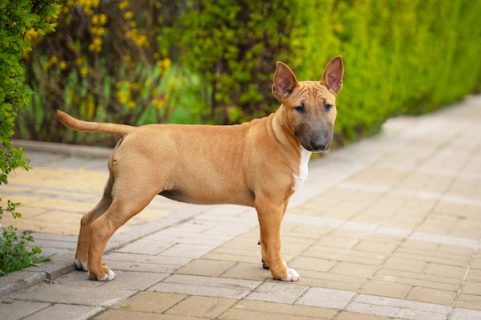
Photo of a red Miniature Bull Terrier puppy by Ирина Мещеряковаr/iStock