A hippopotamus (one of the most dangerous land mammals) might seem an unlikely place to begin a discussion of purebred dogs, but here we are. We cite the hippo because she gives us an on-ramp to the “hippopotamus muzzle” of the Chinese Shar-Pei, one of those wonderfully visual dog expressions that can become misleading when the nickname substitutes for the actual construction.
Before we get to the standards, however, there are two other expressions worth knowing: “meat-mouth” and “bone-mouth.” Neither sounds particularly elegant, but each tells us something. A heavily padded Shar-Pei muzzle is commonly called a meat-mouth; a less-padded muzzle is called a bone-mouth, the more traditional of the two. These are descriptive terms, not the names of two separate breeds.
So why the difference, and who prefers what?
The answer begins with different ideas about the appearance worth preserving. DOGS NSW distinguishes the original Chinese Shar-Pei from the type that became popular in the West, explaining that people in southern China, Hong Kong and Macau call them bone-mouth and meat-mouth, respectively. The fuller, fleshier muzzle became associated with the Western type, while breeders devoted to the traditional type preserve a less-padded head. That is a broad historical distinction, not a rule that every Chinese breeder prefers one and every Western breeder the other.
Traditional-type advocate Sandra Lindberg describes a small population maintained by breeders committed to preserving the original dogs rather than crossing them with the more modern meat-mouth type. She also cautions that traditional Shar-Pei differ in more than their muzzles: bone structure, coat and overall conformation enter the picture, too. “Bone-mouth,” in other words, is not simply a meat-mouth with the padding removed.
There is biology behind the difference as well as breeder preference. Research links the Shar-Pei’s thickened, folded skin to increased production of hyaluronan, a substance that binds water in tissues. Genetic changes near HAS2, a gene involved in making hyaluronan, help explain that characteristic skin. Researchers have identified variants they call “traditional” and “meatmouth.” The fullness is not simply a matter of a dog having more facial fat.
What these sources do not establish is that heavier muzzle padding made a better hunter, guardian or fighting dog. We should not invent a working advantage merely because a feature is distinctive. The documented explanation concerns breeding history, selection for appearance and inherited skin characteristics—not proof that a fleshier muzzle performed a job better.
And here is where the terminology needs a little care: shape and quantity of padding are not quite the same thing. The familiar, heavily padded muzzle is associated with the meat-mouth, but “hippopotamus” should not be translated as “as much padding as possible.” DOGS NSW describes a hippo-like appearance from the front, yet its published standard allows the lips and upper muzzle to be only “slightly padded.”
AKC, UKC and FCI all use “hippopotamus” to describe the muzzle, but none leaves breeders and judges to work from the mental picture alone. Their detailed clauses explain what must create it.images.
AKC calls for a muzzle that is “broad and full with no suggestion of snipiness.” The distance from nose to stop approximately equals the distance from stop to occiput—the back of the skull—and the lips and top of the muzzle are well padded. That padding may produce a slight bulge above the nose.
UKC gets particularly specific. Its muzzle is broad and deep, with plenty of fill beneath the eyes and no taper from stop to nose. The square appearance comes from correct bone structure combined with padding of the muzzle and lips. Not wrinkles alone.
FCI likewise requires breadth from the root of the muzzle to the tip of the nose, without tapering, along with well-padded lips and upper muzzle. Its wording permits a bulge “at the base of the nose.”
These requirements tell us what judges applying those standards must look for. They do not instruct judges to reward the greatest amount of flesh, nor do they turn “meat-mouth” into permission for exaggeration. UKC lists excessive head wrinkling in adults as an eliminating fault. FCI specifies that lower-lip padding must not interfere with the bite, while UKC lists a lower lip folding over the lower incisors—“tight lip”—as an eliminating fault.fci+1
Wrinkles describe folds of skin; padding describes fullness. Neither replaces the required muzzle construction. A heavily wrinkled head can still lack the breadth and shape the standard requires.images.
The bone-mouth and meat-mouth discussion adds history to the picture: different breeders have preserved or favored different expressions of the breed. The hippopotamus comparison gives us a memorable outline. But whether we are discussing traditional type or reading a modern show standard, a colorful nickname is still no substitute for knowing the dog behind it.
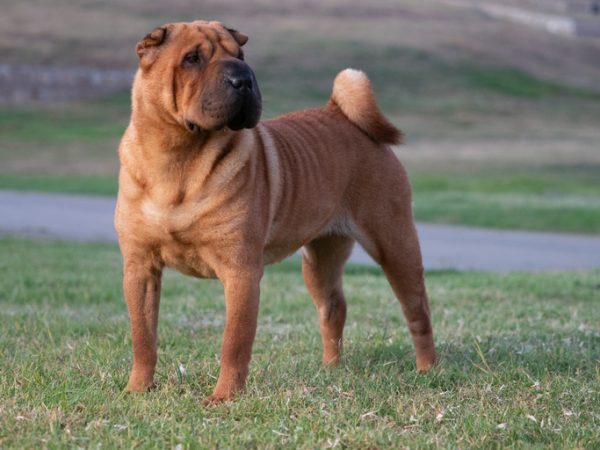
Photo of a “meat mouth” Chinese Shar-Pei by marcelinopozo iStock