The British expression “going pear-shaped” usually means something has gone wrong. For an Old English Sheepdog, it can mean something has gone right! The breed standards of both the United Kennel Club and the Royal Kennel Club explicitly call for a pear-shaped body when viewed from above.
The AKC standard doesn’t use those words, but its description—“broader at the rump than at the shoulders”—explains the same relationship. Square-looking from the side and pear-shaped from above are not contradictory descriptions. They are different views of the same dog.
Our favorite question on these pages is ‘why,’ so we have to ask: Why should the body of a dog with a serious working history resemble one of the ingredients of a fruit bowl?
The answer starts with the dog, not the outline. An Old English Sheepdog should have a short, compact body, well-sprung ribs and a deep, capacious brisket. Its loin—the region between the last ribs and the pelvis—should be stout and gently arched; the British standard also specifies that it is broad. Add round, muscular hindquarters and a rump broader than the shoulders, and the characteristic overhead shape takes form. The pear is the sum of those parts, not a shape imposed on top of them.
“Narrower at the shoulders” is a comparison, not a request for a narrow-chested dog. The OES is supposed to be thick-set, muscular and able-bodied. Its ribs must be well sprung, but the AKC standard rules out both slab sides and a barrel chest. This is a substantial dog whose front and rear differ in width. It is not a pinched front attached to an exaggerated backside.
Does a pear outline, by itself, makes a dog a better worker?
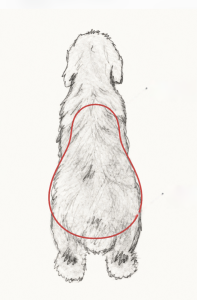
Between our own crude drawing, and Canva, we imagined how this pear shape would look superimposed on an OES
It is the construction behind the outline that makes the dog work. Put another way, the outline is just the visible result; the construction behind it is what makes the dog perform efficiently.
Writing in judging guidance published by the Old English Sheepdog Club of America, breeder-judge Mary Anne Brocious describes the OES as a drover’s dog developed to move cattle long distances over rough terrain. She identifies both endurance and agility as parts of its working equipment: the ability to travel steadily, but also to take off quickly, gallop, turn, twist and reverse when the job requires it.
The breed’s stout, gently arched loin, round muscular hindquarters and well-let-down hocks contribute to its capacity to move tirelessly in different gaits. The loin should be short, broad and muscular, with the ribs extending well back and a deep brisket providing room for the lungs needed for sustained work. These are working attributes, not simply ingredients for an interesting outline.
There is no advantage, however, in treating the rear as though it works independently of the front. Balance is crucial, with good extension in front and good drive behind. The AKC standard describes the desired trot as free, powerful and seemingly effortless, covering “maximum ground with minimum steps.” For a dog expected to cover distance, efficient, coordinated movement matters. A broad rump by itself can’t supply it.
That distinction matters because “more” is not the aim. The British standard warns that desirable features must be present in the right measure, while the AKC places type, character and balance ahead of size alone. The goal is a correctly proportioned OES, not the largest possible rear or the most dramatic pear.
The breed’s topline is another part of the picture, but it describes height rather than width. An OES stands lower at the withers than at the loin. The rise belongs over the loin, not the hip bones. It should be gentle, not extreme, and should not be created by a swayback, unusually short front legs or very straight stifles.
We are comparing the shoulders and rump. From the side, we are looking for the characteristic rise toward the loin. Neither description gives permission to exaggerate the dog.
And then there’s that hair.
The pear comparison describes the dog beneath the presentation—not a silhouette that grooming alone should create. The structural requirements remain a compact body, a rump broader than the shoulders, and a stout, gently arched loin.
Coat does contribute to the finished appearance. The standards call for heavier coat over the hindquarters, but they also prohibit artificially changing the natural outline. The AKC and UKC make an exception for trimming the feet and rear for cleanliness; the Royal Kennel Club says the outline should not be artificially changed by scissoring or clipping.
That is why judging an OES (and any coated breed, to be honest) requires hands on — and in — the dog’s coat, as well as one’s own eyes. Grooming can hide a multitude of faults, but it can hide correct structure, too. How a dog is built beneath the coat rather than accepting the presented silhouette as proof is critical Hair can’t supply a muscular loin or correctly built hindquarters that just aren’t there.
As for why “pear-shaped” is absent from the AKC standard, we never found a reason, but the standard does describes the width relationship directly, while the parent club’s judging guidance itself uses “pear-shaped” to explain the overhead view.
For an Old English Sheepdog, going pear-shaped is not a grooming accomplishment or a joke about its figure. It is a shorthand description of breed-specific construction: compact, strong and broader behind than in front, with the balance needed to put those parts to work. So the next time someone says it all went pear-shaped, remember: for an Old English Sheepdog, that’s the goal.
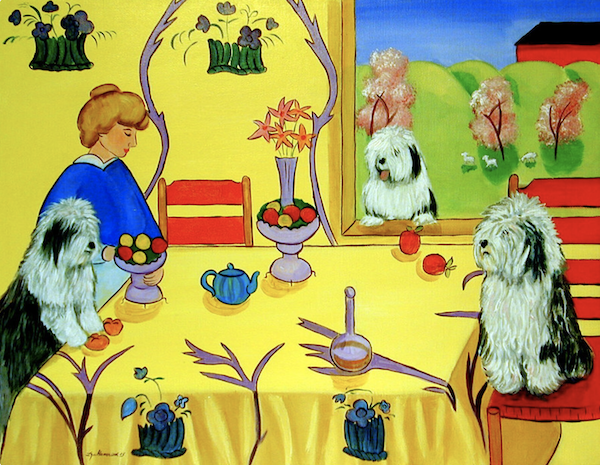
Image: Old English Sheepdog Giclée by Lyn Hamer Cook from DogArtByLyn with consent
www.facebook.com/PetArtbyLyn
www.petart.net
www.corgiart.net