
Every owner of a puppy has a quest: Get the little chap paper-trained.
Every movie involving foreign intrigue seems to include the line, “Do you have your papers?”
Paper trails can lead to vindication—or arrests.
And the Federalist Papers helped make the case for the United States Constitution.
Another trove of papers known as the Capstaff Papers had a rather narrower constituency: German Wirehaired Pointer fanciers. And while 1,086 pages of correspondence, pedigrees, registration applications, and photographs might not be everyone’s idea of a good time, some of us would happily cancel lunch.
What makes the papers interesting isn’t simply their age or their volume. It’s what they may help us learn about the dogs and people behind the German Wirehaired Pointer’s 1959 AKC registration.
If you’ve ever followed a pedigree backward and wished you could put a face to a name—or ask the owner a few questions—finding a collection like this can feel like striking gold.
The woman whose name appears on the collection was Dr. Genevieve Capstaff, whom the AKC Library & Archives describes as “a foundation breeder of German Wirehaired Pointers.” The archive also notes that the German Wirehaired Pointer Club of Illinois honors her with an annual memorial chukar shoot — a fitting remembrance for someone involved with a sporting breed.
Born in 1916, Genevieve Capstaff was in her early forties during the period covered by the papers. Her connection to the breed extended much further: SandStorm Kennels credits her and Jan Fast as the breeders of Stogie, a German Wirehaired Pointer born in 2001, when Genevieve was 84. She died in 2013 at 96. How is that for duration?
Her papers, dated 1958–1959, preserve records concerning the German Wirehaired Pointer Club’s foundation stock for AKC breed registration. Held by the AKC Library & Archives, the collection consists of three PDF files preserved on a compact disc.
The first, “GWP correspondence Book 1,” contains 279 pages of records, mostly correspondence. There are lists of dogs and owners, correspondence with AKC, breed standards, and scans of some photographs. “GWP Pedigrees Book 2” adds 390 pages, including provisional registration applications completed by owners, with supporting material such as pedigrees and photographs of their dogs. The third file, “GWP Pedigrees Book 3,” continues that material for another 417 pages.
For breeders, these papers offer a starting point for investigating which dogs were submitted for registration, what ancestry their owners documented, and what the correspondence with AKC addressed. For owners who simply love the breed, the photographs and records offer the possibility of getting acquainted with individual dogs and the people behind them.
For all of us, however, the Capstaff papers illustrate that while AKC recognition of a breed can sound like a single administrative decision, there is significant human and documentary labor behind it: assembling pedigrees, documenting foundation stock and corresponding with the registry. Hardly an overnight endeavor.
A caveat: We’ve not read the papers. Our account is based on the archive’s catalog description, not our own perusal of the three files. Specific dogs, application outcomes, and Capstaff’s exact role in the registration effort remain to be established from the documents – but that is the appeal of primary sources. They give us something to investigate rather than another account to repeat. A recognition date tells us when a milestone occurred. The Capstaff papers offer a chance to learn more about how people worked toward it. What a treasure trove for a GWP fancier, and a fine reminder that if you’ve been in your breed for a time, save your papers! They might be tomorrow’s gold mine.
The catalog lists the collection as open to research without restrictions. Anyone interested in consulting it can ask the AKC archivist about collection AKE-20-11; anyone wishing to reproduce material should consult the archivist about publication permission.
Lunch can wait.
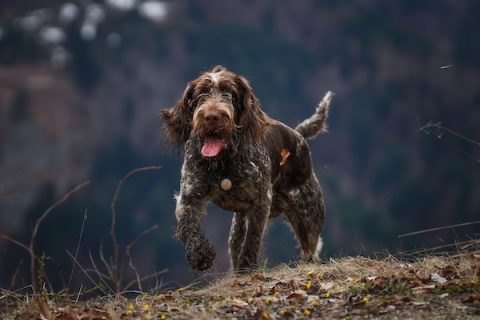
Photo of a German Wirehaired Pointer by Andreas Schnabl/Pexels