Beamers. You know the cars.
Bavarian to the core, BMWs are precision‑built, purpose‑driven machines, shaped by the same landscape that gave them their name. Their famous emblem—a circular “roundel” with a black outer ring and the letters BMW framing blue-and-white quarters—wears Bavaria’s colors right on the hood. Some people think that the logo represents a spinning propeller—a nod to the company’s early aircraft engines—the more accurate explanation points to heraldry. The alternating blue and white fields are drawn from the flag of Bavaria, the region where the company was founded.
The Bavarian Mountain Scent Hound has been recorded in the AKC’s Foundation Stock Service since 2016, recognized by the United Kennel Club since 1996 (as the Bavarian Mountain Hound), and registered with the FCI as the Bayerischer Gebirgsschweißhund.
Its defining characteristic is its highly refined “cold nose”—the ability to follow a track many hours old. What distinguishes the Bavarian, however, is not just sensitivity, but discrimination and method. This is not a dog that rushes a line. Working on a long lead, it methodically reconstructs the path of wounded game, sorting through crossing scent, shifts in terrain, and environmental disruption. It remains committed to the specific track it has been given, even in the presence of fresher scent from the same species. In practical terms, the dog is not merely following odor, but resolving it—integrating ground disturbance, individual scent, and traces of blood or tissue into a coherent line.
Little wonder. The breed descends from the ancient Bracken, Central European hounds long prized for their trailing ability. As hunting practices shifted away from pack pursuit toward the recovery of wounded game, a different kind of dog was needed—lighter, more agile, and more closely bonded to a single handler
Developed in the mountainous regions of Bavaria, it was refined for exactly this purpose: to be capable of navigating steep terrain on leash while working in close cooperation with its handler. It stands in contrast to heavier relatives such as the Hanoverian Scenthound, which is more substantial in build and historically suited to different conditions.
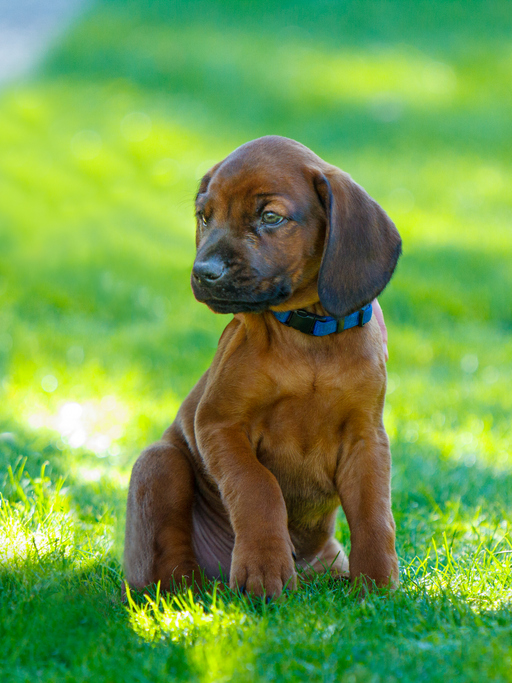
Photo of a Bavarian Mountain Scent Hound puppy by FotoES
The breed’s coloration—typically described as “deer red,” ranging from deep red to fawn with darker shading—is not incidental. Genetically, it most closely reflects expression at the Agouti (A) locus, particularly the fawn or sable pattern (ay), which produces a red to yellow coat often accompanied by darker-tipped hairs. The richness of the color is influenced by multiple modifying genes affecting pigment intensity, and many individuals display darker overlay along the topline—a hallmark of sable expression rather than a separate pattern.
A black mask, when present, is associated with the Eᵐ allele at the MC1R (Extension) locus, allowing localized eumelanin expression on the muzzle. Darker ears reflect similar concentrations of pigment. Small white markings on the chest may occur and are typically linked to limited expression at the S (white spotting) locus, though minimal white is preferred.
Functionally, this coloration serves the dog well. Muted reds and browns blend into leaf litter, bark, and shadow, while darker shading reduces contrast in broken forest light. Whether or not it was deliberately selected as camouflage in the modern sense, it is a coat that works—visually unobtrusive in the environments where the dog performs its task close to the ground.
Today, the breed remains tightly controlled in its country of origin. In Germany and Austria, Bavarian Mountain Scent Hounds are placed primarily with professional hunters and gamekeepers, and breeding stock must demonstrate working ability through formal tracking tests known as Schweißprüfungen. The breed is not preserved as a relic of the past, but maintained as a functional tool—indispensable in the ethical recovery of wounded game.
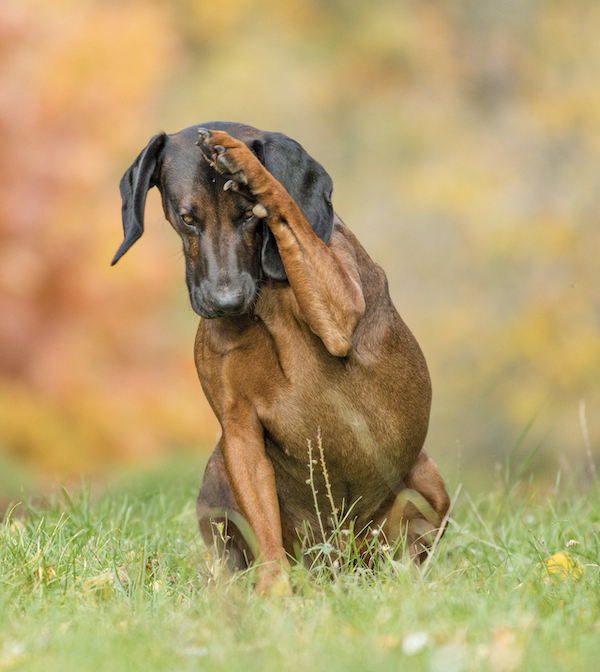
Image of Bavarian Mountain Scent Hound/iStock