“Plenty of bone” and “round bone” may sound like two ways of describing the same thing, but they aren’t. One describes how much bone; the other describes its shape—and breed standards give us good reasons not to confuse them.
“Plenty of bone” sounds like uncomplicated praise. A dog has substance, is far from looking spindly, and gives the impression that he is built for the job.
Fair enough. But substituting “round bone” changes the description. We’re no longer talking simply about the amount of bone. We’ve now introduced a particular shape, and that shape may not be what the breed’s standard requires.
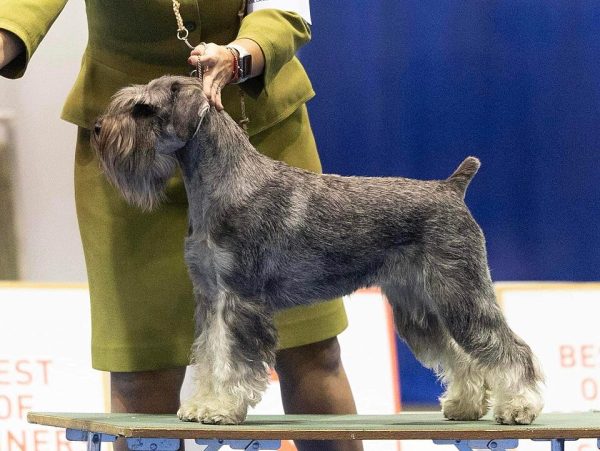
The Standard Schnauzer’s AKC standard describes a robust, sturdily built dog with “good muscle and plenty of bone.” Its forequarters section further specifies “heavy bone.” Neither phrase, however, tells us that the bone must be round. Substituting “round” would add a requirement the standard does not state.
Let’s consider two breeds with “Australian” in their names and who work with livestock.
The Australian Cattle Dog’s standard explicitly calls for forelegs with “strong, round bone, extending to the feet.” The Australian Shepherd’s standard is equally explicit: “Bone is strong, oval rather than round.” It also describes the Aussie as “solidly built with moderate bone.” Both standards require strength, but they don’t prescribe the same bone shape—or make maximum substance the goal.
That little comparison is worth pausing over. Round isn’t another word for strong, and oval isn’t another word for slight. The Australian Shepherd standard asks for strength and oval bone in the same sentence. We don’t have to choose between them.
The German Wirehaired Pointer makes the distinction even harder to miss. Its standard requires leg bones that are “flat rather than round, and strong,” adding that they must not be so heavy or coarse as to interfere with the dog’s natural agility. Here, shape, strength, and the limits of acceptable heaviness are addressed in a single passage. Flattened bone is plainly not being offered as an apology for insufficient substance.
More isn’t automatically better, either. Even when a standard calls for substantial bone, the rest of the dog still gets a vote, so to speak.
The Harrier standard asks for “plenty of bone” in the forelegs, but immediately qualifies that requirement with “not overburdened.” Elsewhere, it calls for as much substance and bone as possible “without being heavy or coarse.” Those qualifications belong to the description just as surely as the word “plenty” does.
The Great Pyrenees offers another useful caution. Its standard describes a dog of “medium substance whose coat deceives those who do not feel the bone and muscle.” It faults both excessive and insufficient bone when either is out of balance with the frame. An impressive outline, in other words, isn’t the whole examination.
We don’t need to invent an engineering explanation for every difference. These breed standards establish what their respective breeds should have; they don’t tell us that one bone shape is universally stronger, faster, or able to leap tall buildings in a single bound.
The point is simpler, and useful enough on its own: “plenty of bone” and “round bone” should never be treated as interchangeable descriptions. They answer different questions, and a dog can satisfy one description without satisfying the other.
Breed standards are particular that way. Before anyone thinks to improve the wording with a convenient synonym, it pays to check whether it changes the dog.
Image: Pepper-and-salt Standard Schnauzer. Photo by Standardschnauzer1, CC0, via Wikimedia Commons.