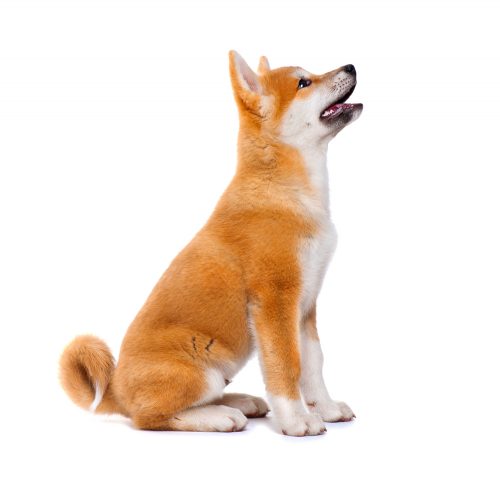
In Akita Inu—and more broadly among the Nihon Ken (native Japanese breeds)—roppaku is a traditional marking term that literally means “six whites.” In Akita, it refers to a dog with white points on the face, the four feet, and the tail tip, and is especially associated with brindle dogs where this distribution of white is preferred. The term appears in Nihon Ken glossaries alongside related concepts such as hachiware (split‑face or broad blaze) and pinto (excessive white), so it is understood across the Japanese breeds as part of a shared marking vocabulary even though its strongest, standard‑level usage is in Akita Inu.
Roppaku is distinct from urajiro, which describes a softer, symmetrical white underside pattern with gradual transitions from the main coat color to white on the cheeks, chest, belly, inside of the legs, and underside of the tail. In roppaku, the white can form sharper boundaries and doesn’t have to be perfectly symmetrical. When you add up the white areas—four feet, facial white, and tail tip—you arrive at the nickname “six white.”
In Western coat‑color genetics, a roppaku‑like distribution of white is broadly comparable to what many authors call an Irish‑spotting‑type pattern (white limited to the extremities, underside, tail tip, and facial markings). However, Japanese breeders use their own traditional terms (roppaku, urajiro, hachiware, etc.), and the underlying genotype in Nihon Ken may not match exactly the classic Irish spotting allele described in other breeds, so it’s better to say the patterns are similar rather than identical.
Image: Akita Inu puppy/DepositPhoto