
We have an update to this post which you’ll find at the end.
As the story goes, Matthias, a young Hungarian of high birth, liked to go hunting incognito. During one of his hunting trips, he and a young peasant girl named Helen (or Ilonka in Hungarian) met each other in the woods, and it was love at first sight. Sadly, Matthias had to return home, but he told Ilonka to visit him in Buda.
Young love is urgent, and as soon as she could, Ilonka sped to Buda. Upon her arrival, she found herself in a large crowd that had gathered to welcome their king home from a victorious battle. One can only imagine Ilonka’s shock to see that the King of Hungary sitting in his full regalia on horseback was her own Matthais. Convinced that a king would never marry a simple peasant girl, Ilonka lumbered home overcome with grief, and soon thereafter, died of a broken heart. For Matthias’ part, he hadn’t seen Ilonka in the crowd, but two weeks later, he went back to her house and found it empty.
A heartbreaking story.
Hungary did have a King Matthias Corvinus, a monarch so beloved that he was considered a second Messiah and the ultimate philosopher king, but was there really an Ilonka? Possibly. Matthias’ first wife, Catherine of Podebrady, died in childbirth just three years after they married, but he had never really loved her for their’s had been a marriage of convenience – his. It was said that Matthias’ true love was Szép Ilonka, or Helen the Beautiful who met the king while he was traveling in disguise.
True or not, the story was recorded by the court historian, Galeotto Marzio, and popularized by the nineteenth-century poet and dramatist, Mihály Vörösmarty. Later, the legend was commemorated in an enormous stone fountain by sculptor Alajos Stróbl, and installed in 1904 by Alajos Hauszmann, master builder of the reconstruction of the Royal Palace. It appears against the wall of the western forecourt wing of Buda Castle.

It is an amazingly ornate, beautifully crafted sculpture, and the longer one looks at it, the more is revealed about the poignant love story. Now called the Matthias Fountain, the sculpture depicts a royal hunting scene with the bronze figure of King Matthias holding a crossbow in his hand, standing near a dead stag (modeled after deer that was killed in 1896 by poachers in the forest where Stróbl went hunting). To the left is a seated Galeotto Marzio who recorded the story of Beautiful Helen. Compositionally speaking, it is his figure that makes the Fountain symmetrical, but his distance from the center also suggests that he is free from fear, writing the story of King Matthias with impartially. On the other side is Szep Ilonka who appears to be feeding a young deer but looking over her shoulder as if to protect her fawn from the hunters. To complete the scene are the gamekeeper as well as a shield bearer, both holding hunting horns.
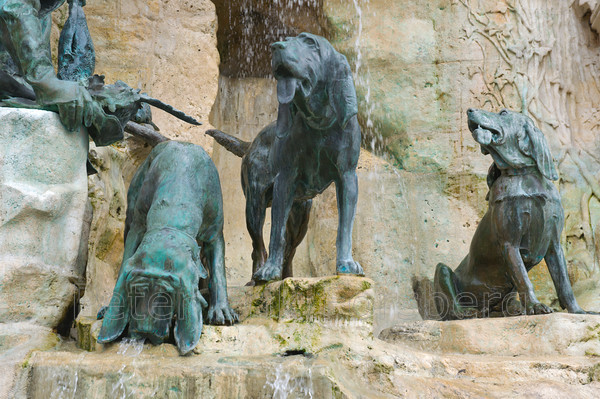
At Marzio’s feet there are three large hunting dogs said to be Vizslak (their image is at the top, and frankly, they more resemble Bloodhounds, at least to our eye). The Kuvasz is more closely associated with King Matthias Corvinus who established his own breeding program, in large part because he trusted his dogs more than his own Royal Guardsmen. It’s said, in fact, that he kept at least a brace of Kuvaszok with him at all times. Still, the ancient Vizsla was a hunting dog, and it’s appropriate that it should appear in the sculpture.
As an aside, the Fountain survived the destruction of the World War II except for the destruction of the middle dog blown up during the war. Dog-loving Hungarians quickly had an exact copy made, though some complain that it lacks the quality of the original.
If you visit Budapest, you’ll want to visit the Neo-Baroque fountain, not only because it is one of the most frequently photographed landmarks in the Hungarian capital, but because throwing a coin in the fountain is said to ensure a safe return trip to Budapest.
Update: A reader recently wrote in suggesting the fountain’s central dogs might actually be Bracco Italiano — Italy’s ancient pointing breed, known for the same long, houndy ears we noted above. That comment sent us back down the research rabbit hole.
Detail image of dogs by Peter Erik Forsberg
These dogs are Bracco Italiano
Thank you for the kind of engagement we love from NPDD readers. We revisited the topic and no documentation we’ve found supports Bracco Italiano for the Matthias Fountain dogs. If you know differently and have verified sources, we’d love to see it. Here’s what we found.
The 1904 fountain (Mátyás-kút), sculpted by Alajos Stróbl with architect Alajos Hauszmann, is catalogued in György Rajna’s authoritative 1989 reference, Budapest köztéri szobrainak katalógusa (Budapesti Városszépítő Egyesület) — the standard scholarly inventory of Budapest’s public sculpture. It confirms that Duke Pálffy personally sent Stróbl a live hunting dog to use as a physical model for the bronzes (kozterkep.hu).
The best documentation actually comes from Hungary’s National Hauszmann Program, the government heritage body that carried out the fountain’s full 2020 restoration. Their official account identifies the three central dogs as belonging to Count Újlaky, King Matthias’s regular hunting companion, and — this is the detail that really updates our original piece — describes the single dog seated at Galeotto Marzio’s feet not as a Magyar Agár, but as an “orosz agár,” a Russian sighthound, i.e., a Borzoi (Lelépő, citing the Nemzeti Hauszmann Program).
So the popularly repeated “Vizsla” label for the central trio is a traditional shorthand rather than a documented breed identification, and it’s easy to see why we or another reader might look at their heavy heads and pendulous ears and think “hound” rather than “Vizsla” — again, we said the same thing back in 2019, noting they look more like Bloodhounds to us (our own Matthias Fountain piece). But across every art-historical and official restoration source we could locate — the 1989 sculpture catalog, the National Hauszmann Program’s restoration materials, and Hungarian heritage press coverage of the 2020 reopening (PestBuda, Index.hu) — Bracco Italiano simply never appears.
We’ll be updating our piece to reflect the Borzoi correction. Thanks again for pushing us to dig deeper — this is precisely the kind of scrutiny that makes NPDD better.