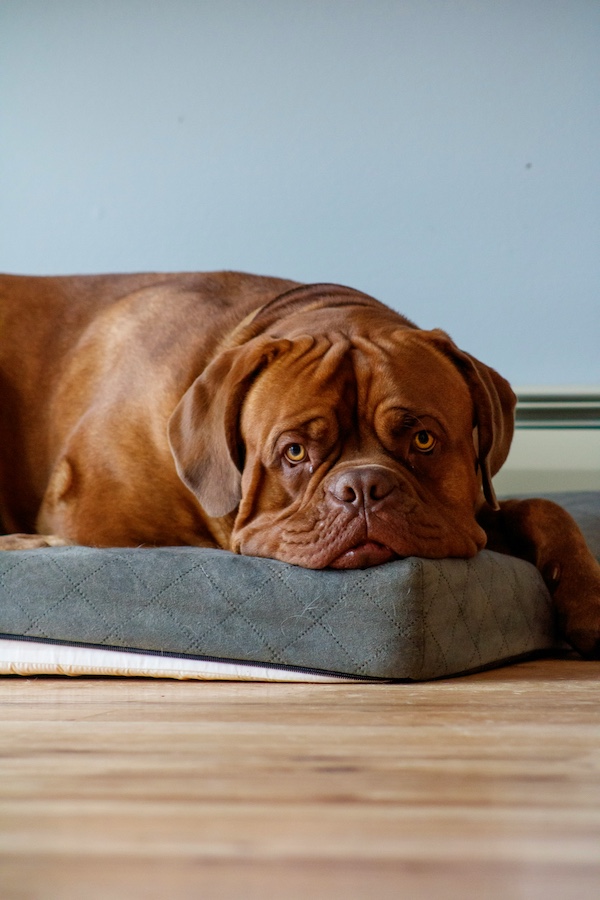
Oh, those glorious facial wrinkles of the Dogue de Bordeaux. They are part of the breed’s distinctive head—but more is not always better.
An older FCI standard already described symmetrical wrinkles on either side of the median groove as “deep ropes of wrinkle” that move according to whether the dog is attentive. The FCI standard published in 2009 kept that description and became more specific about two facial wrinkles: the one running from the inner corner of the eye toward the corner of the mouth is typical; the one running from the outer corner of the eye toward the mouth or dewlap, if present, should be discreet. The same standard lists “bulldoggy hypertype” as a severe fault, describing, among other features, a swollen fold behind the nose and a substantial fold around the head.
Nor is the answer to do away with the wrinkles.
The AKC standard calls a massive head with proper proportions and features an important breed characteristic, describes the Dogue’s “serious expression,” and retains both the “deep ropes” language and the guidance on the two eye-to-mouth wrinkles. In my view, those wrinkles help give the Dogue its unmistakable expression; an overemphasized outer-eye wrinkle can change its character. That is an interpretation of the standard, not a fault the standard assigns to a “sad” look.
The Royal Kennel Club takes a more restrained approach to the wording. Its standard calls for a head “slightly furrowed with fine symmetrical wrinkles … but without excess” and says the skin should be thick and loose fitting, “without excessive wrinkles.” Separately, its Breed Watch guidance asks judges to watch for eyelids that turn inward or outward and fail to contact the eyeball normally, as well as irritation in skin folds. The common thread is a characteristic Dogue head—not exaggeration at the expense of soundness.
Image: Dogue de Bordeaux by Jacob Narkiewicz/Unsplash