“That dog could serve you cocktails on its back and not spill a drop.”
In many breeds, a level topline is a really good thing because it reflects a flat, strong back that allows efficient and balanced movement without wasted effort. It usually indicates good spinal support and core muscling while showing proportioned and angled front and rear assemblies that “meet in the middle.” Roughly put, it can serve as a quick visual indicator of overall balance.
And then there is the Manchester Terrier. Its breed standard states the following: “The topline shows a slight subtle arch over the robust loins falling slightly to the tail set. While standing or in motion, a flat or roached back is a serious fault for both varieties.”
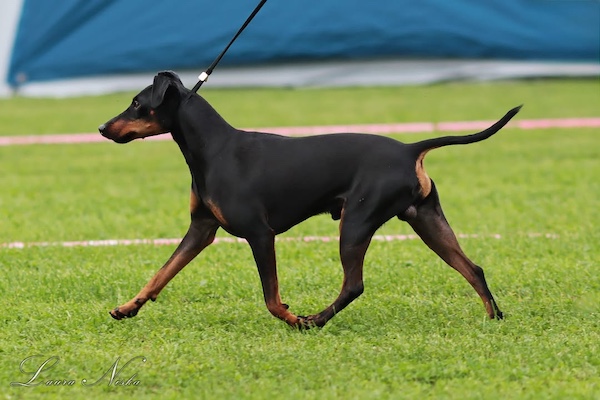
Photo of Sari Kanerva’s dog, Black Idol’s Twister, photographed by Laura Niska with consent
“Why” is a favorite question on these pages, and so we ask: How (or why) does flat or roached back impact this breed in its original function as a vermin hunter?
To answer this, we should mention that a roached back is not the same as a subtle arch. The former is an exaggerated, rigid arch of the entire back. The Manchester’s “subtle arch over the loins falling slightly to the tail” is a mild rise confined to the loin that blends smoothly into the croup and tail. A true roach is seen as a pronounced, convex bow with the highest point often well behind the withers. It tends to shorten and stiffen the spine, and usually reflects or causes compromised mechanics often seen in an inefficient gait. By contrast, the Manchester’s topline is level over the back, then just softly lifts over well-muscled loins before easing down toward the tail, preserving flexibility and power in the loin without the rigidity, inversion of curves, or overall spinal distortion seen in a roached back.
Remember the breed’s original purpose. The Manchester is a “vermin hunter extraordinaire.” Hunting rats and mice requires explosive speed from a standstill. A slight arch over strong loins allows the rear assembly to coil and release like a spring, and gives the Manchester a stronger yet more flexible “bridge” between their front and rear. It improves acceleration, agility, and endurance needed in a dog that had to sprint, coil, and pivot all day in pursuit of rats in tight spaces.
It is also illustrative of breed type, a reflection of its ancestry. Around the early 1800s, Black and Tan Terriers were cross bred to Whippets. This contributed a racy outline with an arched back, and, in essence, married terrier ratting instincts to a flexible, speed-oriented topline that supports quick bursts and efficient movement. The breed was renamed the Manchester Terrier as the Manchester district of England became the breed center.
To the world outside of the dog fancy, breed standards may seem like fussy aesthetic wish lists, but in reality they are blueprints that preserve the form, function, and history of a breed so it can continue to do the work for which it was created generation after generation. That slight arch over the loins is the difference between a merely pretty dog and a purpose‑built vermin assassin.
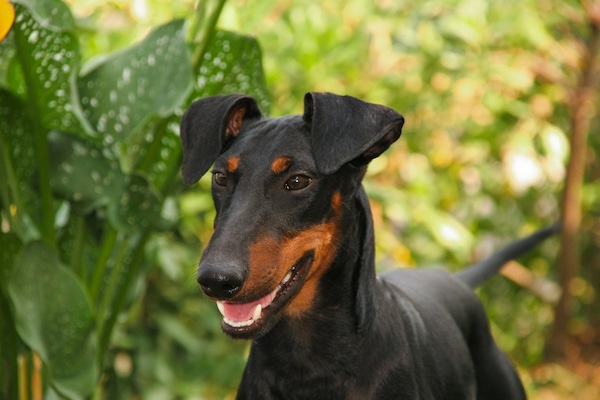
Photo of Manchester Terrier by Wirestock/Depositphotos