Behind every great quotation stands a real person, and behind many great people there is, quite often, a dog.
Nelson Mandela did not write the words, “I am the master of my fate: I am the captain of my soul.” The words close William Ernest Henley’s poem Invictus, written in 1875 and first published in 1888. Mandela nevertheless became closely associated with the poem’s defiant stoicism after his years of imprisonment under apartheid. He was widely reported to have drawn strength from it during his incarceration, and accounts say he recited it on Robben Island. The sentiment suits the public Mandela: resolute.
But before the prisoner, statesman, and global emblem, there was a younger Mandela at home in Soweto—with a dog.
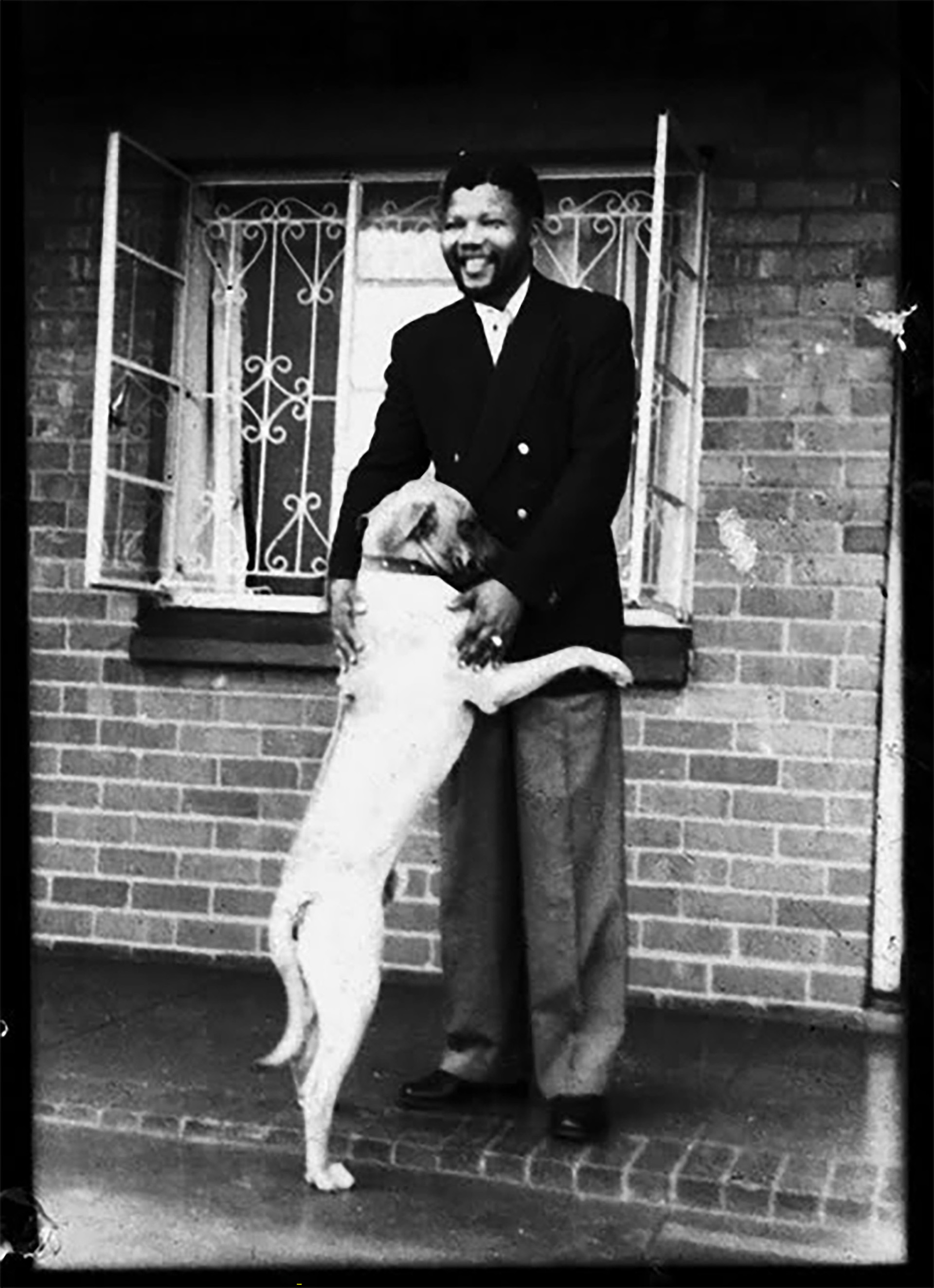
The dog was Gompo, widely described as a Rhodesian Ridgeback. In a 1959 photograph by the acclaimed South African photojournalist Alf Kumalo, Mandela is relaxed outside 8115 Vilakazi Street in Orlando West, playing with Gompo. The archival caption identifies Gompo simply as “the family dog.” In another image, Gompo peers through the gate, a small but striking reminder that even a household under increasing political pressure still contained the ordinary rhythms of family life: a front gate, a modest yard, and a dog keeping watch.
No. 8115 was no country farm, and Gompo was no theatrical “lion dog” posed against the African veld. It was a small, four-roomed urban house in Orlando West, Soweto, built in 1945. Mandela moved there with his first wife, Evelyn Ntoko Mase, in 1946. After Nelson and Winnie Madikizela Mandela married in June 1958, Winnie joined him there. The home would become a place shaped by activism, harassment, surveillance, and turmoil, but it remained a family home.
That makes Kumalo’s picture more than a charming celebrity-and-dog photograph. Mandela’s easy posture as he plays with Gompo lets us see the man before the mythology hardened around him: a husband, father, lawyer, organizer, and dog owner standing in the doorway of his own life.
Gompo’s breed offers an unexpected connection to another of the world’s best-known dogs: the Dalmatian.
In 1922, F. R. Barnes drafted the first formal standard for the Rhodesian Ridgeback in Bulawayo, then in Southern Rhodesia. Rather than reinvent the wheel, Barnes used the Dalmatian standard as his model for language and structure. Surviving accounts do not identify the particular Dalmatian standard or kennel-club edition Barnes consulted, so it would be a mistake to call it an AKC or FCI standard. We just don’t know. That said, the original Ridgeback standard was approved by the South African Kennel Union in 1926.
Barnes’s decision gave the emerging Ridgeback a practical structure. A comparison of the early Dalmatian and Rhodesian Ridgeback standards shows parallels in the sections addressing general appearance, head and skull, eyes, ears, neck, forequarters, hindquarters, body, feet, tail, and coat. The Dalmatian standard therefore offered Barnes a useful template and, in places, familiar phraseology. The Rhodesian Ridgeback standard used that framework to set down its own distinct ideal.
If Barnes left behind a definitive explanation for choosing the Dalmatian standard in particular, we haven’t found it. It is tempting to infer that the Dalmatian standard could accommodate the kind of dog Barnes wished to describe: a symmetrical, active, clean-lined dog built for speed and endurance. But that would be our inference from the standards themselves, not a recorded explanation from Barnes.
A later Rhodesian Ridgeback Club handbook recounts that Barnes described his use of the Dalmatian standard as having “poached” it. If the wording is accurately preserved, it is a remarkably frank acknowledgement of the borrowing. What can be established without speculation is that the Dalmatian standard offered a practical starting point for the first formal Ridgeback standard—and that the result endured. Despite later revisions to matters including size and color, the 1920s standard remains recognizably the foundation of the breed description used today.
The historical oddity still appears in the Fédération Cynologique Internationale’s classification: both the Dalmatian and the Rhodesian Ridgeback are listed in Group 6, “Scent hounds and related breeds,” Section 3, “Related breeds.” The current FCI Rhodesian Ridgeback standard also states in its brief historical summary that Barnes’s 1922 standard was based on that of the Dalmatian and was approved by the South African Kennel Union in 1926. The shared classification is a matter of kennel-club nomenclature; it is not, in itself, evidence that the two breeds are closely related genetically.
Gompo’s is a small story, but not an insignificant one. In the photographs that survive, we see Mandela as a man at home with the family dog. Sometimes that is the more revealing kind of history.
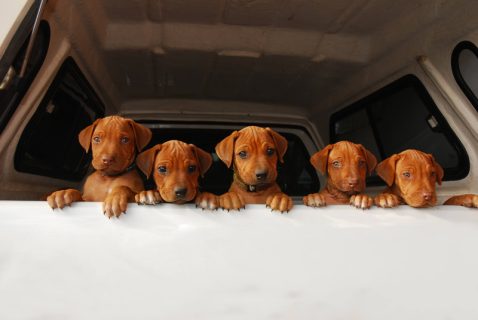
Image of Rhodesian Ridgeback puppies by Anke Van Wyk/Dreamstime