Of all the people to own an Irish Setter, the one we might least expect is a 19th century Russian—and not just any Russian, but an emperor.
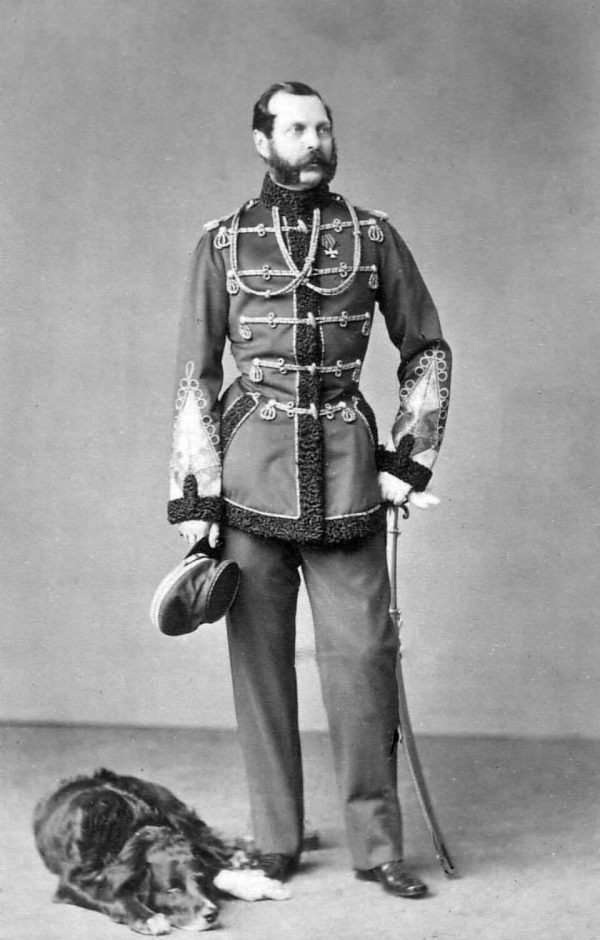
Alexander II, remembered as the Tsar-Liberator for emancipating Russia’s serfs in 1861, kept at his side a remarkable setter named Milord. The Royal Collection Trust identifies the dog lying at Alexander’s feet in one of its formal photographs as the Emperor’s Irish Setter, though some Russian museums and historical sources call Milord a black Irish Setter or simply a black setter. Other sources describe the dog as “red veiled by black-tipped hairs,” an apparent contradiction not easily resolved as photographs (including the one you see here) are monochrome.
One commonly repeated account comes from Leonid Sabaneev, the Russian naturalist, sportsman, and authority on hunting dogs, who said that he had seen Milord himself at Ilyinskoye. Sabaneev described him as an exceptionally large and handsome dog with a beautiful head and abundant coat—but one possessing little setter type. His legs were too long, Sabaneev thought, and one was entirely white. He added that Milord was said to have been given to Alexander by “some Polish gentleman,” and that rumor held the dog was not entirely purebred.
Thus far, we have found no breeder, pedigree, or Irish kennel that can be connected to Milord with confidence. What we find important, however, is that the Royal Collection Trust identifies him as an Irish Setter—and that whatever questions others raised about his breeding, Alexander evidently cared very little. Milord was his dog, and that seems to have been pedigree enough.
Milord was celebrated not as a perfect specimen but as an exceptionally devoted companion. He was permitted to sleep in the imperial apartments and accompanied Alexander on walks through St. Petersburg’s Summer Garden. People who did not recognize the Emperor’s face reportedly recognized the large setter trotting near him. One official history calls the dog Alexander’s “special identifying mark.”
Milord occasionally made those walks memorable. In one account, he snatched an elaborately prepared birthday pretzel from a schoolboy’s hand and demolished it in a puddle. Alexander comforted the distraught boy, and an officer later arrived at his school with a replacement cake and several pounds of sweets. In Yalta, Milord reportedly bit a merchant who accidentally stepped on his foot. Far from complaining, the man declared the wound a treasured reminder of the day he had met the Tsar-Liberator.
Milord also shared Alexander’s sporting life. Alexander II was a passionate hunter whose imperial establishment maintained carefully selected packs and gundogs. According to T. F. Bulgakova’s essay in the Tsarskoye Selo exhibition catalogue, although the imperial kennels contained excellent hunting dogs, Milord was the dog Alexander loved best and took hunting most often. We never found what game he worked, how Milord hunted or whether he worked like a trained hunting dog. The evidence simply establishes his presence on hunts—not how good he was at it.
Milord apparently left “little Milords,” (read: descendants). Later accounts mention a daughter named Dora, although her dam, ownership, and precise place in Milord’s line remain uncertain. A firmer connection leads to Leo Tolstoy. Sabaneev wrote that Tolstoy—whose father-in-law, Andrei Bers, was a physician associated with the Moscow Palace Office and a setter owner—raised “one of the puppies from the imperial dogs” at his country estate. Later breed histories identify that puppy as the product of a mating between Milord and one of Bers’s purebred Irish Setter bitches, but we haven’t found a record confirming those unions. As far as we can tell, evidence suggests that Milord probably sired puppies, but not how many or whether any traceable line descended from him.
Our hearts broke as we read that in 1867, Alexander traveled to Paris for the Exposition Universelle without Milford who was left behind at Tsarskoye Selo. The Emperor and his dog were almost never separated, and according to the traditional account, Milord pined, refused food and died while Alexander was away. His death was supposedly concealed from the Emperor until his return lest his visible grief be interpreted as anxiety over political affairs.
Milord was buried in the imperial dog cemetery in the “Garden of Alexander I” at Tsarskoye Selo. A white marble slab bore the words: “The kindest and dearest faithful Milord. 1860–1867.”
Those dates probably record the period during which Milord belonged to Alexander, beginning with his arrival in 1860. They don’t prove that the dog was whelped that year, so his exact age at his death remains unknown. The marble marker was recorded in a 1918 inventory but was reportedly lost in 1934. The Tsarskoye Selo account also says Alexander commissioned sculptural memorials featuring Milord after the dog’s death.
We confess to have gotten confused deeper in our research because Alexander subsequently had another cherished dog also named Milord, but we came to learn that this Milord was apparently a Newfoundland. This Milord accompanied the Emperor during the Russo-Turkish War and survived him, eventually going abroad with Alexander’s widow, Princess Catherine Yurievskaya. Anyone inclined to dig deeper into the Emperor’s dogs should be aware that any “Milord anecdotes and portraits” should perused carefully before they are assigned to the setter or the Newf.
We many never know the purity of Milord’s lineage, but what is certain is that the setter achieved something no pedigree could confer: he became one of the most recognizable dogs in imperial Russia and the almost inseparable companion of its emperor.
Image: Alexander II and Milord – 1870 by Sergei Lvovich/Public domain