Most people don’t read an article and immediately wonder if there is a purebred dog angle they can work into a post, but we do. Sometimes we’re rewarded with very plausible connections, such as our piece on redheads. Other times, the thread is tenuous at best, but we tend not to let a tortured route to a point stop us from sharing what we find.
This post is inspired by an article about an important set of numbers.
Every American beyond toddlerhood knows what “911” means. When said as individual digits, nine – one – one, the three numbers are ingrained in the collective consciousness to mean an emergency that needs immediate attention.
But it wasn’t always so.
Before the mid-1960s, Americans got in touch with emergency services by calling their local fire or police department, or dialing (yes, we wrote “dialing”) “0” for the operator. It wasn’t until 1968 that AT&T and the Federal Communications Commission (FCC) announced that they had decided on a new, universal three-number sequence for emergency calls in response to growing calls for a single emergency number — 911.
And we were wayyyy behind. The United Kingdom had been using its universal emergency number, 999, since 1937, and was the first country in the world to roll out such a system. We honestly don’t know how the UK settled upon 999 as their emergency number, but we know why 911 was chosen in the US, and it came down, in part, to the technology of the time. With the exception of a lucky few homes, touch‑tone button phones didn’t become commonplace until the late 1970s and early 1980s.
Those of us of a certain age remember that it took far longer to “dial” a phone number on a rotary dial than it did to punch the number in using a button keypad. Using 911 was not only easy to remember, but it was quick to dial even in the dark because “9” and “1” were at opposite ends of the dial. Dialing “9” took slightly longer than “1” on a rotary phone, and the sequence was also chosen because it was short, easy to standardize across existing systems, and avoided conflicts with other numbering codes in use at the time.
Today, around 240 million calls are made to 911 in the U.S. each year (that’s more than 650,000 emergency calls every single day), and we hope you never have to make one of them.
We could only think of one number that similarly evokes an instant image in a dog person’s mind. The number is 101, and it is, of course, tied to the Disney movie, 101 Dalmatians. It’s a number that makes many Dal owners cringe since registrations surged dramatically following the film’s releases, creating a classic “price of popularity” cautionary tale for the breed.
A more “dog nerd” angle could be FCI standard numbers. Every FCI-recognized breed has an official breed-standard number, so a number can literally point to a breed. The Dalmatian is FCI No. 153, the German Shepherd Dog is FCI No. 166, the Rough Collie is FCI No. 156, and the Old English Sheepdog is FCI No. 16. It’s far less familiar to the general public, but it is wonderfully “inside baseball” for purebred dog readers.
We conclude, however, with our own favorite example: SZ 1. German Shepherd Dog fanciers will recognize that, within the SV (Verein für Deutsche Schäferhunde) registry, the number 1 holds a singular and almost sacred place tied to a foundational figure. In 1899, German cavalry captain Max von Stephanitz attended a dog show in Karlsruhe, where he encountered a dog named Hektor Linksrhein whose type and working potential embodied his ideal. He purchased the dog, renamed him Horand von Grafrath, and soon after founded the SV. Horand was entered as SZ 1 in the society’s studbook, making him the first officially registered German Shepherd Dog in that registry. From that point forward, the breed was developed under von Stephanitz’s direction, and virtually all modern German Shepherd Dogs trace their lineage back to this pivotal “Number 1.”
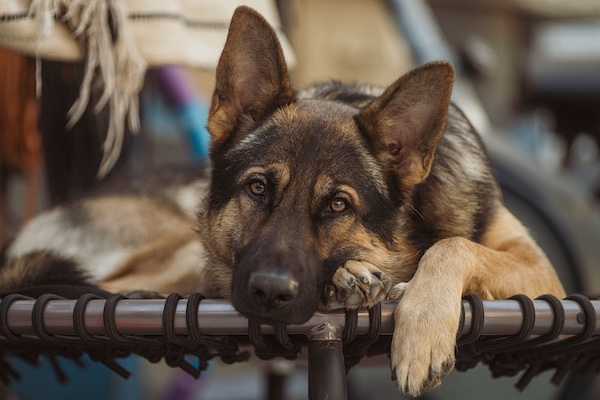
Image: A German Shepherd Dog from Mechelen, Flanders, Belgium shared by Inge Van den Heuvel