
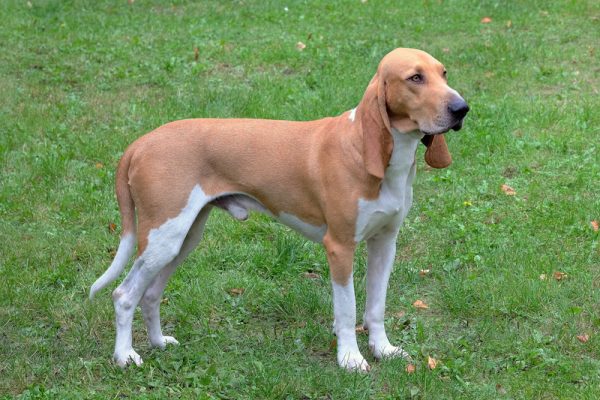
Are you familiar with the Swiss Hound?
Known in its homeland as the Schweizer Laufhund, this Swiss scenthound has a history extending far beyond the modern show ring. The Fédération Cynologique Internationale cites a mosaic discovered at Avenches, the site of the Roman settlement of Aventicum, as evidence of packhounds corresponding to Swiss Hound varieties in Roman Helvetia. The FCI also notes that Swiss hounds were sought by Italian dog fanciers in the 15th century and by the French in the 18th century for hare hunting.
The breed’s native hounds were influenced by French scent hounds brought back to Switzerland by mercenaries. Yet the Swiss Hound developed as a distinctly Swiss hunting dog: a medium-sized, enduring scenthound intended to work independently and give tongue on the trail of hare, fox, roe deer, and sometimes wild boar.
Swiss Laufhunde are often described as among Europe’s oldest scenthounds. It is important, however, to distinguish the long history of Swiss running hounds from the later establishment of formal varieties and written standards. In 1882, standards were established for five varieties: the Bernese Hound, Jura Hound, Lucerne Hound, Schwyz Hound, and Thurgovie Hound. When the standards were revised in 1909, the Thurgovie Hound was recorded as having disappeared. On January 22, 1933, a single standard was adopted for the four surviving varieties: Bernese, Jura, Lucerne, and Schwyz.
The breed was under real pressure by the end of the 19th century. Amazing dog historian, Ria Hörter, citing Swiss canine historian Dr. Hans Räber, wrote that there were hardly any purebred hounds available in the 1890s. She identified several factors: many hunters didn’t insist on pure breeding, and hunting with Laufhunde had been prohibited in some parts of Switzerland because the dogs’ ranging style could damage crops and fields.
Broader changes in hunting culture also formed part of the background. Hörter notes that after the French Revolution, Switzerland’s nobility had to share hunting rights with civilians and that hunting increasingly became a practical “meat hunt.” That social change should not be presented as a single direct cause of the breed’s 1890s scarcity, but it helps explain the changing conditions in which traditional hound packs were kept and used.
In 1903, J. Staub of the Swiss Kennel Club founded the Swiss Hound club, described in the historical account as the Schweizerische Laufhunde-Club. The breed is now represented by the Schweizerischer Laufhundclub (SLC). In 1907, according to Hörter’s account, an appeal was made to save the Swiss Hounds from extinction. The club bought good-quality hounds and placed them with careful breeders and huntsmen.
The same account says that working-test rules were introduced to encourage greater control in the field. A hound was expected to hunt singly, remain under control while searching for game, return to its handler within half an hour if lost, and come back immediately when the hunting horn sounded. These rules were intended to discourage uncontrolled hunting behavior and to require owners to train their hounds properly.
Exports also helped extend Swiss Hound bloodlines beyond Switzerland. Swiss hounds—particularly white-and-yellow Schwyz Hounds—were exported to Scandinavia, and Hörter reports that roughly 1,200 Swiss Hounds were bred in Norway between 1902 and 1922. This is consistent with the SLC’s own historical record that a Schwyz Hound sold to a Norwegian buyer in 1901 became a foundation dog for Norway’s Schwyz population.
Today, the Swiss Hound remains first and foremost a hunting breed. The FCI standard describes it as “lively and passionately keen on hunting,” but also sensitive, docile, and very attached to its master. A well-bred, properly exercised, and thoughtfully socialized Swiss Hound may be an affectionate companion, but prospective owners should be realistic: this is an active, independent scenthound with endurance, a strong desire to follow scent, and a voice developed for work in the field.
The United Kennel Club recognized the Swiss Hound in 2006. UKC recognizes the Bernese, Jura, Lucerne, and Schwyz varieties together as the Swiss Hound.
Photo of Swiss Hound by RadomA-r ReA 3/4 nA 1/2 | Dreamstime